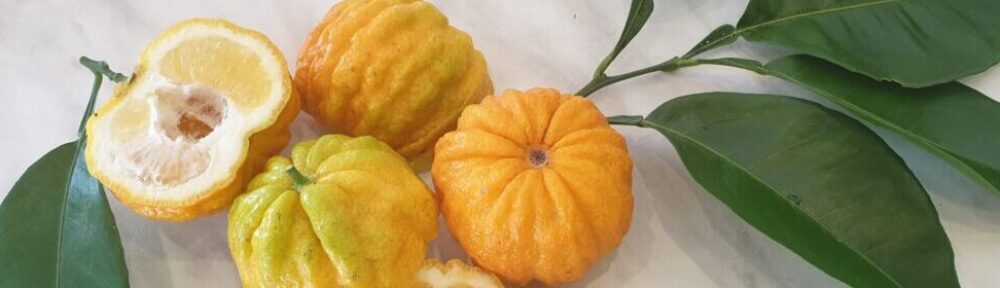
Japanese name: Yuge Hyōkan (弓削瓲柑; alternative romanisation: Yuge Hyōukan), read “yuge hyōkan”; literally “gourd citrus of Yuge” — from Japanese Yuge (弓削; name of an island in the Seto Inland Sea archipelago, Ehime Prefecture), hyō (瓲, gourd) and kan (柑, citrus), referring both to the characteristic fruit shape and to the locality where the cultivar was preserved
English name: Yuge flask orange; also rendered Yuge Hyokan in English-language literature
SYNONYMS
- Hyōkan Hort. (ひょう柑) — abbreviated form commonly used by growers, particularly on Shikoku and in adjacent areas (Muchachaen, 2021)
- Tōkan Hort. (唐柑) — historical local name recorded among farmers of the Seto Inland Sea coast; alludes to the continental or Taiwanese origin of the original Hyōkan cultivar (Muchachaen, 2014)
Note on synonymy: The name Citrus yuge-hyōkan Hort. ex Y. Tanaka appears in Tanaka’s (1946) monograph as nov. sp. (new species). Tanaka explicitly distinguishes this taxon from Hyōkan (C. ampullacea Hort. ex Tanaka, no. 67 of the same volume) on the basis of morphological characters and seed embryony. Neither GBIF nor IPNI list C. yuge-hyōkan as a validly published combination separate from C. ampullacea; the taxonomic treatment in this article respects Tanaka’s distinction as scientifically justified and genomically supported (Shimizu et al., 2016).


TAXONOMIC NOTE
Yuge Hyōkan is a Japanese cultivated citrus described by Tanaka (1946) as the new species Citrus yuge-hyōkan Hort. ex Y. Tanaka in the same volume of his monograph in which the related Hyōkan (C. ampullacea Hort. ex Tanaka, no. 67) is also described. Tanaka treated both as distinct species, differentiating them on several characters, of which the most significant taxonomically is seed embryony: Yuge Hyōkan is described as polyembryonic (Tanaka, 1946), whereas Hyōkan bears exclusively monoembryonic seeds (Tanaka, 1946; NARO Genebank, 2026). Additional morphological differences include a lower segment count in the flesh (approximately 9 in Yuge Hyōkan versus approximately 12 in Hyōkan), fruit shape and further botanical characters (Tanaka, 1946).
The genomic analysis by Shimizu et al. (2016), encompassing 101 representative Japanese citrus cultivars with 123 SSR markers and organellar genomes, placed Yuge Hyōkan (accession A205) in an entirely different genomic context from Hyōkan (accession A035). The cytotype of Yuge Hyōkan is C04 (pummelo type). Allele-sharing analysis identified as the most probable parent either Naruto (A095, C. medioglobosa hort. ex Tanaka) or Ujukitsu (A197, C. ujukitsu hort. ex Tanaka), with the second parent remaining unidentified. Ujukitsu may alternatively be a descendant of Yuge Hyōkan, as may Kawachi bankan (Shimizu et al., 2016). This genomic picture points to multi-generational hybridisation with Kishu (C. kinokuni hort. ex Tanaka) in the background: Naruto is itself an inferred descendant of Kishu and an unidentified pummelo cultivar. The genomic context of Yuge Hyōkan thus differs fundamentally from that of Hyōkan, whose origin is inferred as a direct cross of Kunembo with a pummelo cultivar (Shimizu et al., 2016). Shimizu (2022) confirmed that Kishu is an indirect parent, via Naruto or Kunembo, of 24 Japanese cultivars including Yuge Hyōkan.
Whether Yuge Hyōkan arose in Japan as a natural hybrid in a garden setting or as the result of deliberate breeding remains unanswered.
HISTORY AND ORIGIN
The discovery in Kumamoto and Tanaka’s documentation
According to Tanaka’s (1946) record, the history of Yuge Hyōkan is not entirely clear. The cultivar was first exhibited by Mr Juichirō Sakamoto of Koten village, Kumamoto Prefecture, at a joint citrus fruit competition held in Nagasaki Prefecture in 1929. Tanaka subsequently obtained scions and planted them in the Fruit Tree Garden of the Taihoku Imperial University in Taipei (臺北帝國大學果樹園), where the cultivar was grown from 1930 to 1940 (Tanaka, 1946).
Yuge Hyōkan is thus a cultivar of most likely Japanese origin, identified in Kumamoto and brought to Taiwan by Tanaka for research purposes — not a cultivar imported from Taiwan into Japan. In Taiwan it was probably recorded under the collective name Piào gān (瓲柑) or as C. ampullacea, since Tanaka assigned the separate scientific name C. yuge-hyōkan only when preparing the monograph (Tanaka, 1946). The precise circumstances of the cultivar’s origin in Kumamoto Prefecture and the duration of its existence prior to 1929 cannot be established from available sources
Spread of the cultivar across Japan
The cultivar remained largely unknown outside the Seto Inland Sea area for a long period. On Yuge Island (弓削島), one of the islands of the Setonaikai archipelago in Ehime Prefecture, it was maintained in traditional cultivation in small numbers; from this island it derives its Japanese name (Misuzuame, 2025).. According to records of JA Mishō Ehime, the cultivar was known in the region under the name Hyōkan from at least the 1940s (Muchachaen, 2014).
BOTANICAL DESCRIPTION
Yuge Hyōkan is a shrub or small tree reaching approximately 4 m in height, with a spreading habit and vigorous growth. Leaves are ovate-lanceolate, approximately 9 cm long and 4.5 cm wide, with an acuminate apex and a crenate margin (Tanaka, 1946).
The fruit is characterised by an ovate to ovoid-conical shape with an elongated apex and a flattened base, overall reminiscent of a gourd or a large lemon (Tanaka, 1946). Fruit diameter is approximately 8 cm; length approximately 9 cm; weight ranges from 170 to 350 g depending on growing conditions (Muchachaen, 2021). Compared with Hyōkan (C. ampullacea) the flask shape is less pronounced. The rind is yellow at full maturity, fairly thick (approximately 8.2 mm) and leathery, with a pronounced aromatic layer of oil glands; it can be peeled by hand without tools (Fukumasa-Nakai Naturals, 2025). The flesh is divided into approximately 9 segments (Tanaka, 1946) — compared with approximately 12 in Hyōkan — with a firm yet juicy texture and a translucent, glassy appearance. The white mesocarp (albedo) is thick and bitter; complete removal is recommended for optimal flavour (Muchachaen, 2021}.
Seeds are polyembryonic — a character of fundamental taxonomic significance that distinguishes Yuge Hyōkan from the monoembryonic Hyōkan (C. ampullacea). The flower is solitary, white, with a short pedicel (Tanaka, 1946). Harvest falls between June and August depending on growing conditions (Muchachaen, 2021).
TASTE AND USE
Yuge Hyōkan belongs to the edible table citrus category (kanshō kankitsu) with a balanced flavour profile: sweetness is more pronounced than in the acid-citrus Hyōkan group, bitterness is mild and pleasant — less sharp than in grapefruit — and the aroma is fresh and pleasantly citrusy when the rind is cut (Muchachaen, 2021). In organoleptic assessments it is often compared to grapefruit from which the bitterness has been removed (Fukumasa-Nakai Naturals, 2025). Sugar content is described as above average for this cultivar type; juice yield is abundant (Muchachaen, 2021).
The fruit is suitable for direct consumption after peeling (in the manner of mandarins, or cut into segments), for fresh juice, marmalade and candied peel — a traditional Asian delicacy (Muchachaen, 2021; Misuzuame, 2025). The thick rind is particularly prized for marmalade making; Misuzuame was the first producer to commercialise Yuge Hyōkan marmalade, in 2005 (Misuzuame, 2025).
CONSERVATION AND THE CURRENT STATUS
Japan
After a long period of marginal cultivation confined almost exclusively to Yuge Island and adjacent Seto Inland Sea localities, Yuge Hyōkan has experienced a marked revival of interest since the early twenty-first century. The grower organisation Muchachaen (Aihamaseki, Ehime) began systematic cultivation around 2010 and by 2021 was producing approximately 20 tonnes per year (Muchachaen, 2021). The cultivar is spreading to further islands, including Iwaki Island (Aoilemon, 2026). Saplings are available commercially.
NARO Genebank holds collection accession JP 117507, originating from Kumamoto Prefecture, classified as an introduced landrace and preserved as vegetative material in three clones (NARO Genebank, 2026). This prefecture of origin corresponds to the historical record of Tanaka’s acquisition of scions from Mr Sakamoto of Kumamoto (Tanaka, 1946).
Taiwan
Yuge Hyōkan was brought to Taiwan by Tanaka as a research specimen after 1929 and grown in the Fruit Tree Garden of the Taihoku Imperial University in Taipei from 1930 to 1940 (Tanaka, 1946). Following the end of Japanese colonial administration in 1945, the presence of the cultivar on Taiwan is not attested in available sources
Outside Japan
Yuge Hyōkan is not recorded as a commercially or collection-grown cultivar outside Japan. In Europe the taxon is known from botanical nomenclature; its presence in non-Japanese collections has not been systematically documented.