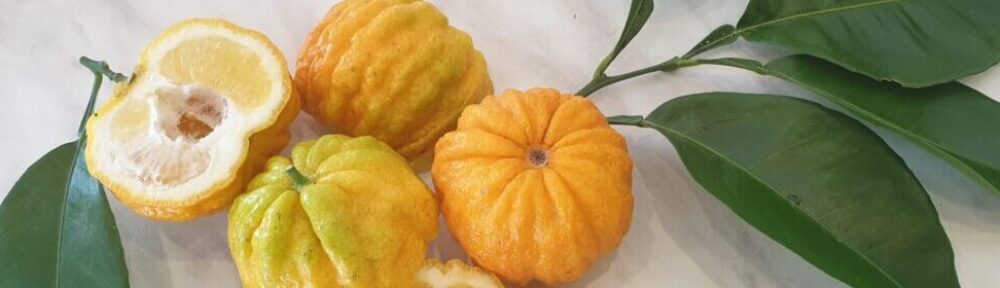
Japanese name: 元祖柑 (Genshōkan)
Taiwanese name: 元宵柑 (Yuanxiao gan), pronounced: “yuan-siao-gan” or simplified as “yensōkan”
SYNONYMS
– Nensho-Kan Hort. ex Tanaka (1927) — the original japanese transcription
– Citrus nobilis Lour. var. genshokan Hayata (1919) — original botanical description from Taiwan
HISTORY AND ORIGIN
Origin in Taiwan:
Citrus genshokan is a cultivar originating from Taiwan (Formosa), where it was described in 1919 by botanist Bunzō Hayata from the northern part of the island as a variety of Citrus nobilis (Hayata, 1919). The Taiwanese name 元宵柑 (Yuanxiao gan, literally “Lantern Festival mandarin”) refers to the ripening time of the fruits, which peaks around the 15th day of the first lunar month (February/March) during the traditional celebration of the Lantern Festival (元宵節, Yuanxiao Jie) (Taiwan Plants Information System, 2025).
Under the Taiwanese name, it is preserved in the botanical collections of National Taiwan University, which maintains two herbarium specimens (T00645, T00646). Although the cultivar originates from Taiwan, no evidence of its current cultivation on the island could be found — neither in commercial production nor in traditional gardens. It appears to have been displaced in Taiwan by commercially more successful cultivars such as Ponkan, Tankan or Murcott.
Introduction to Japan and cultivation on the Amami Islands:
The cultivar was introduced to Japan in the late Meiji–Taishō period (late 19th to early 20th century) probably through the Taiwanese agricultural experimental station. Tanaka elevated this taxon to species status in 1927 and designated it as Citrus genshokan Hort. ex Tanaka, using the Japanese transcription 元祖柑 (Genshōkan, literally “progenitor/original mandarin”) (Tanaka, 1946).
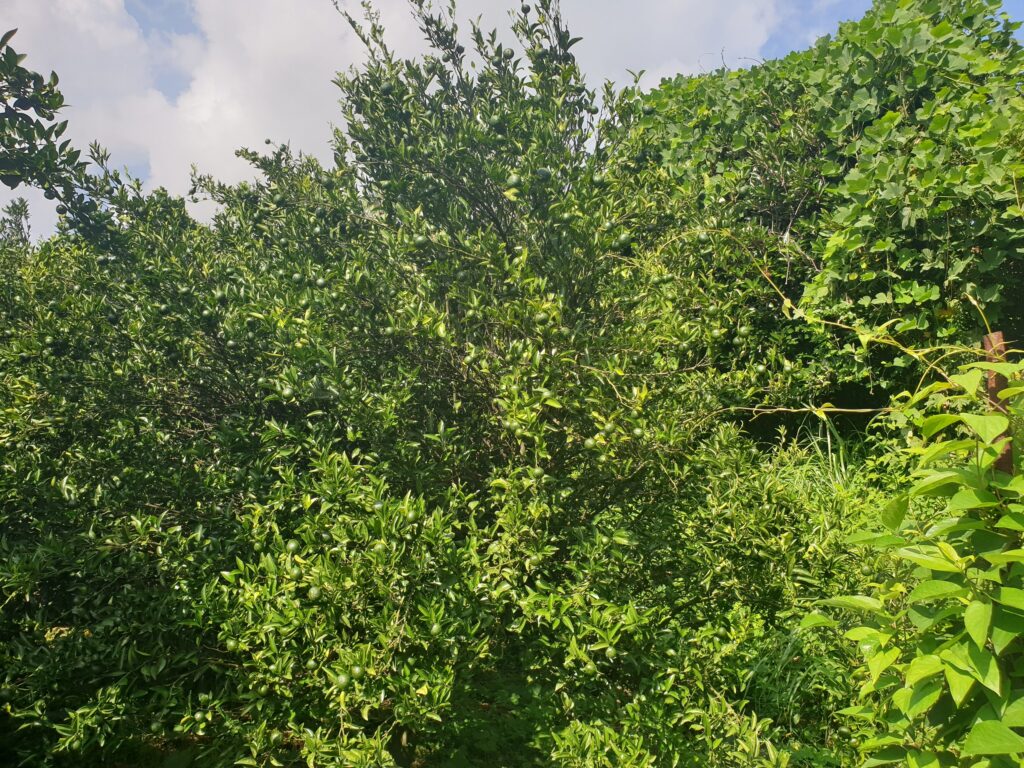
A survey conducted by Professor Yamamoto’s team in 2006 demonstrated that Citrus genshokan was widely distributed on eight islands of the Amami archipelago in Kagoshima Prefecture (Yamamoto et al., 2006). This distribution suggests that the cultivar was introduced to Japan long before modern times and naturalized in the subtropical conditions of southern Japanese islands. Samples collected during this survey were transferred to the citrus collection at Toso Orchard at the Experimental Farm of the Faculty of Agriculture, Kagoshima University, where they are maintained for research and conservation purposes (Yamamoto et al., 2022).
Genetic characteristics:
Shimizu et al. classify genshōkan in a group with more than 90% mandarin admixture, along with Sunki, Cleopatra, Kishu, and others. This places it among the so-called pure mandarin cultivars without proven introgression from pummelo. cpDNA analyses revealed that Citrus genshokan and Citrus leiocarpa (Kōji) share cpDNA Type 6, suggesting a related maternal origin of these two taxa (Inafuku-Teramoto et al., 2013).
BOTANICAL DESCRIPTION
According to Tanaka’s original monograph), the Citrus genshokan tree is of medium stature with a well-structured canopy. In the Toso Orchard collection, specimens reach approximately 3–5 meters in height.
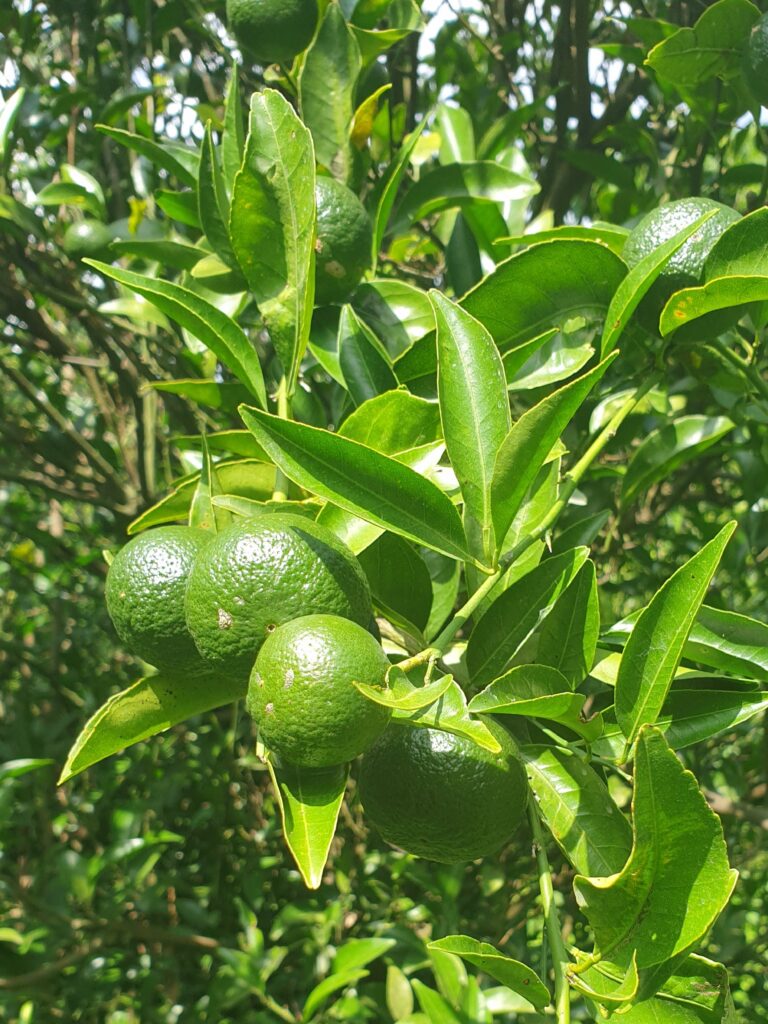
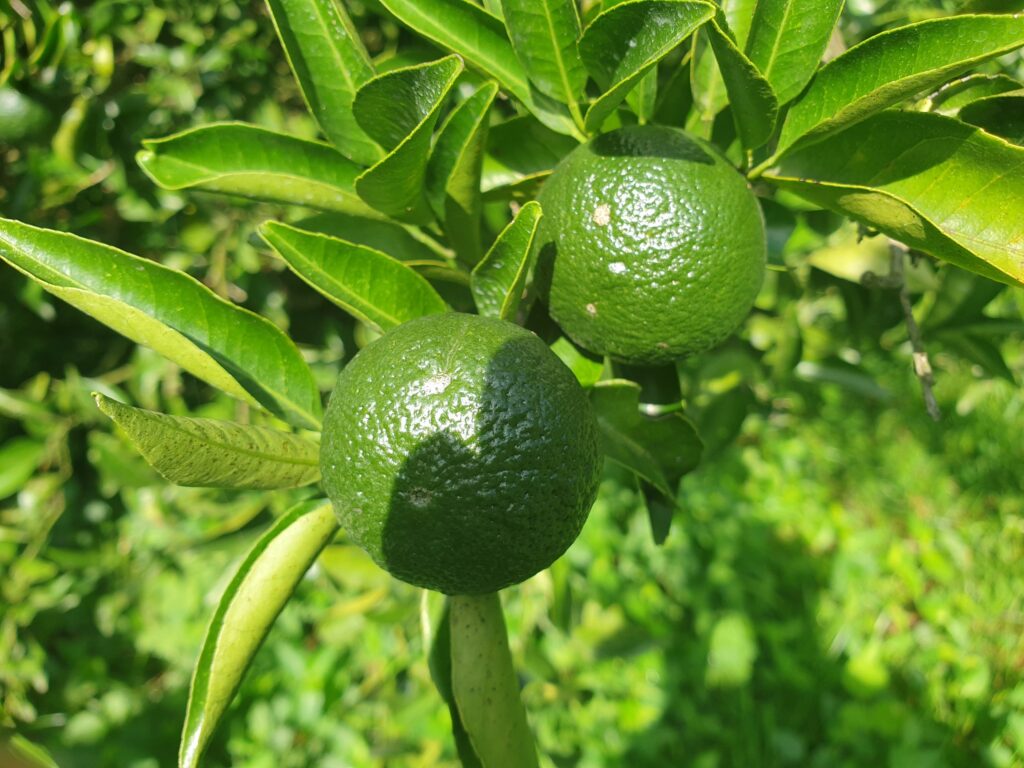
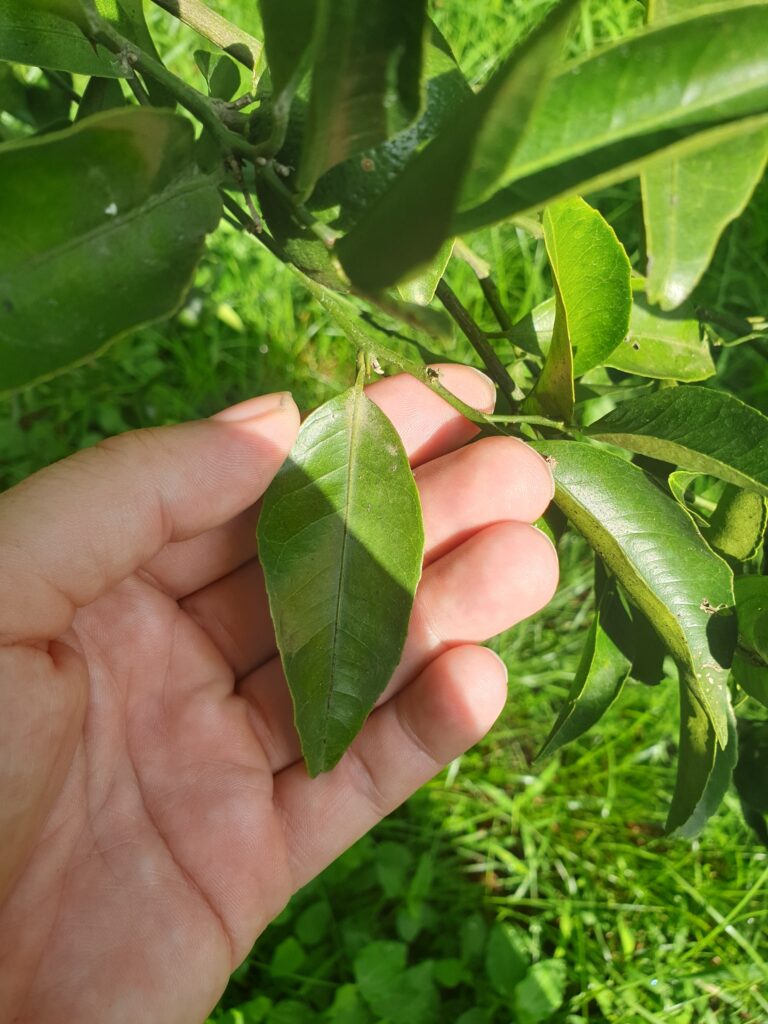
Leaves are small to medium-sized, narrowly elliptic in shape, with minimal to medium wings on the petiole. Flowers are whitish, growing singly or in groups of 2–3. Fruits are medium-sized, globose to slightly flattened in shape. According to Tanaka’s original monograph (1946), fruits reach approximately 54 mm in diameter and 44 mm in height, with a weight in the range of 60–80 g. A characteristic feature is a pronounced depression at the apex of the fruit. The peel is medium-thick (approximately 4.4 mm), with a finely granulated texture — small oil glands are visible on the surface, creating a finely textured appearance. The color of the fruit at full maturity is bright orange. The flesh is orange, moderately juicy. The number of segments per fruit is 10–11, the number of seeds is approximately 15 (Tanaka, 1946).
TASTE AND USE
According to Tanaka’s original monograph the taste of Citrus genshokan is moderately acidic, refreshing. The peel is aromatic and contains essential oils.
Ripening time: The ripening time of fruits varies according to climatic conditions: In Japan, according to Tanaka’s original monograph, fruits ripen in November to December. In Taiwan, where the cultivar probably originated, the ripening time is substantially later — according to the traditional name 元宵柑 (Yuanxiao gan, Lantern Festival mandarin), maturity peaks around the 15th day of the first lunar month, corresponding to the period of February–March in the Gregorian calendar. This difference may reflect different climatic conditions between subtropical Taiwan and the milder areas of Japan, or may indicate the existence of different forms of the cultivar with different phenology
Traditional use:
Consumption of fresh fruits
Refreshing properties — similar to other acidic mandarins
CONSERVATION AND the CURRENT STATE
In Taiwan:
Although the cultivar originates from Taiwan and is preserved in the herbaria of the National Taiwan University (specimens T00645, T00646), no evidence of its current cultivation on the island could be found. It appears to have been displaced by commercially more successful cultivars. Current cultivation of Citrus genshokan in Taiwan is not documented in any available sources
In Japan:
Citrus genshokan is actively preserved in the citrus collection at Toso Orchard at the Experimental Farm of the Faculty of Agriculture, Kagoshima University, which is dedicated to preserving local citrus genetic resources from the Kagoshima region and surrounding islands (Yamamoto, 2006, 2022). Current distribution on the Amami Islands suggests that the cultivar was once more widely cultivated than today, but its current popularity is already limited. However, it still occurs on the Amami Islands.