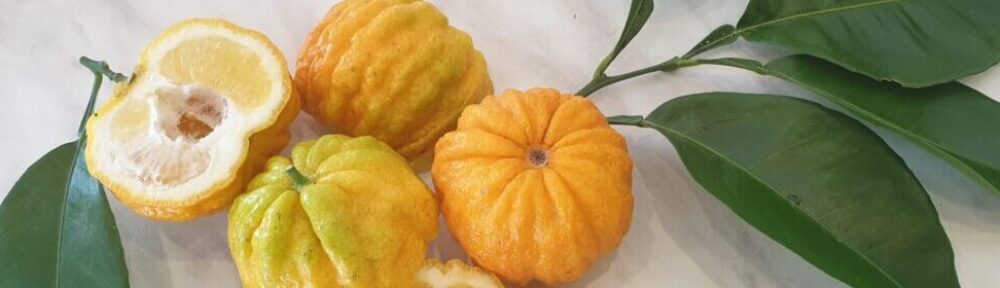
Japanese name: Hebesu; alternative romanisation: Hebezu (ヘベス/ 平兵衛酢); literally “Heibei’s sour citrus” — named after the grower Chŏsokabe Heibei (長曽我部平兵衛)
English name: In English-language trade literature usually referred to directly by the Japanese name Hebesu or Kizu
SYNONYMS
– Citrus × hebesu Hort. ex Fujita — horticultural scientific name based on the cultivating tradition of Miyazaki Prefecture; the most commonly used scientific name in Japanese agricultural and horticultural literature. No verifiable primary publication reference is known from publicly available sources.
– Citrus heibei Hort. ex Hatano — another horticultural name used in Japanese agricultural and horticultural literature. No verifiable primary publication reference is known from publicly available sources.
– Hebezu (平兵衛酢) Hort. — alternative romanisation of the same Japanese name
– Kizu (木酢/ キズ) Hort. — general Japanese agricultural term for the group of aromatic sour citrus fruits originating from Kyūshū; a synonym for this cultivar
Note on nomenclatural priority: According to the POWO / Kew database, the name Citrus kizu Yu.Tanaka was first published in Icon. Jap. Citrus Fruits 2: 411 (1948) and is there recorded as “not validly publ.” (invalid publication under the botanical code). The other names listed above are not registered in IPNI / POWO as valid combinations. The use of C. kizu as the primary name in this article follows the usage of Shimizu et al. (2016).
Note on earlier classification: Mochiyu (木頭柚; Citrus inflata hort. ex Tanaka) is a sour citrus grown in the Naka area of Tokushima Prefecture, morphologically similar to Hebesu / Kizu. Mochiyu is not a synonym for Hebesu / Kizu. Tanaka (1954) erroneously identified Kizu as a synonym for Mochiyu — the same cultivar from a different locality — initiating a taxonomic confusion that persisted for more than sixty years. This hypothesis was disproved by Shimizu et al. (2016): both taxa carry different SSR genotypes and arose independently.
TAXONOMIC NOTE
Hebesu (Japanese: 平兵衛酢) is a citrus cultivar grown mainly in the Hyūga region (日向) of Miyazaki Prefecture on Kyūshū island, with a long tradition in local agriculture and culinary culture. It belongs to the group of Japanese sour citrus fruits that includes kabosu, jabara and sudachi, among others.
The landmark taxonomic contribution is the study of Shimizu et al. (2016), who, by analysing 123 SSR markers and the organellar genomes of 101 Japanese citrus taxa, demonstrated that Hebesu (sample A029, designated in their database as C. junos hybrid) is genomically identical to Kizu (sample A073, C. kizu hort. ex Yu.Tanaka) — number of mismatches MM = 0, number of differing alleles ND = 0. Hebesu and Kizu therefore represent one and the same cultivar recorded in taxonomy under two names from different scientific traditions (Table 4 of that study).
The designation C. junos hybrid in Shimizu et al. (2016) places Hebesu genomically within the complex of citrus fruits related to yuzu (C. junos Sieb. ex Tanaka). From the genealogical synthesis of the same research group (Shimizu 2022) it follows that kunenbo (C. nobilis Lour. var. kunep Tanaka) is a direct parent of Kizu / Hebesu. The second parent is most probably yuzu (C. junos), whose genomic component is present across the entire group of Kizu-related sour citrus fruits. Hebesu has not yet been included in a whole-genome comparative analysis of the scope conducted by Wu et al. (2021) for Ryukyuan citrus, and its exact genomic reconstruction therefore remains an open scientific question.
HISTORY AND ORIGIN
The Hyūga region and cultivation origins
Hyūga (日向) is the historical name for the province that corresponds today to Miyazaki Prefecture on Kyūshū. The region lies on the south-eastern coast of the island, with a subtropical climate favourable for citrus cultivation. The city of Hyūga (日向市) is today the administrative centre of the traditional Hebesu-growing area, situated at approximately 32° N.
According to oral tradition, Hebesu was found and first cultivated during the Edo period (1603–1868) by a local farmer, Chŏsokabe Heibei (長曽我部平兵衛), in the Nishikawauchi Tomitaka area of what is now Hyūga City. The cultivar received the Japanese name 平兵衛酢 (Hebesu / Hebezu), meaning literally “Heibei’s sour citrus” or “Heibei’s vinegar”. The precise date of the discovery, and how long the cultivar had been present in local farming before Chŏsokabe noted it, cannot be determined from surviving sources (Hyūga City, 2020).
Scientific documentation
Tanaka (1948) described a sour citrus from Kyūshū in Volume 2 of An Iconograph of Japanese Citrus Fruits under the scientific name Citrus kizu Yu.Tanaka, within the context of the group of Japanese aromatic sour citrus fruits called kizu (木酢). The cultivar was then known as an agricultural plant of Kyūshū; a direct continuity with the Hebesu cultivar tradition of Miyazaki Prefecture was not explicitly established in that text.
BOTANICAL DESCRIPTION
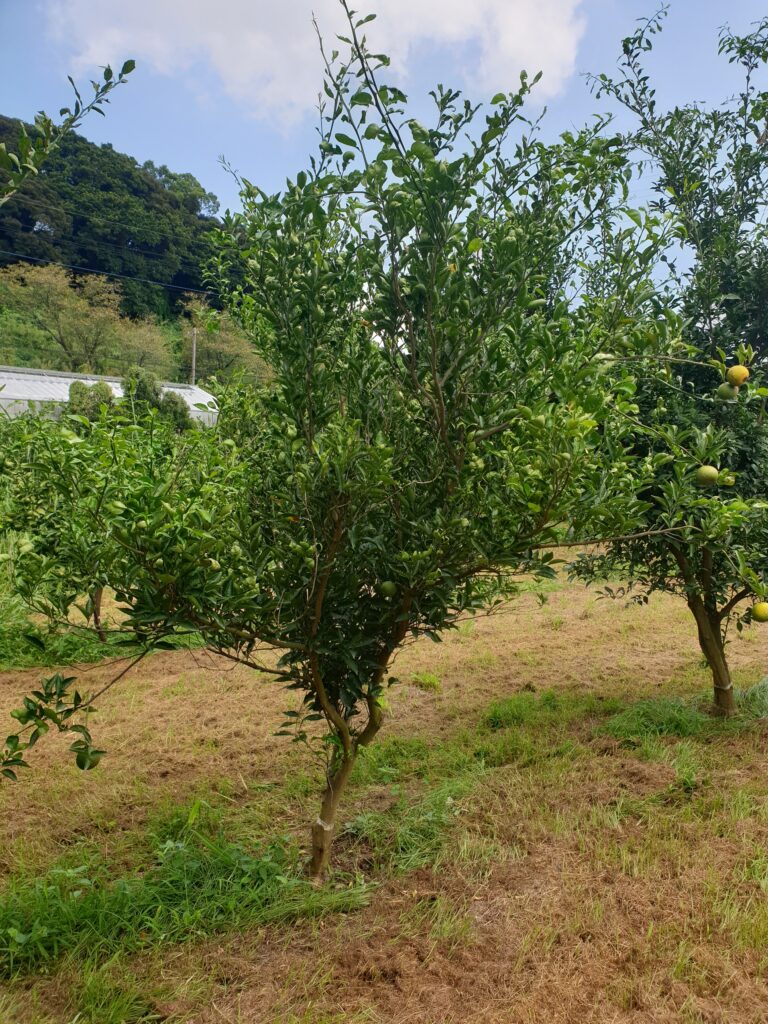
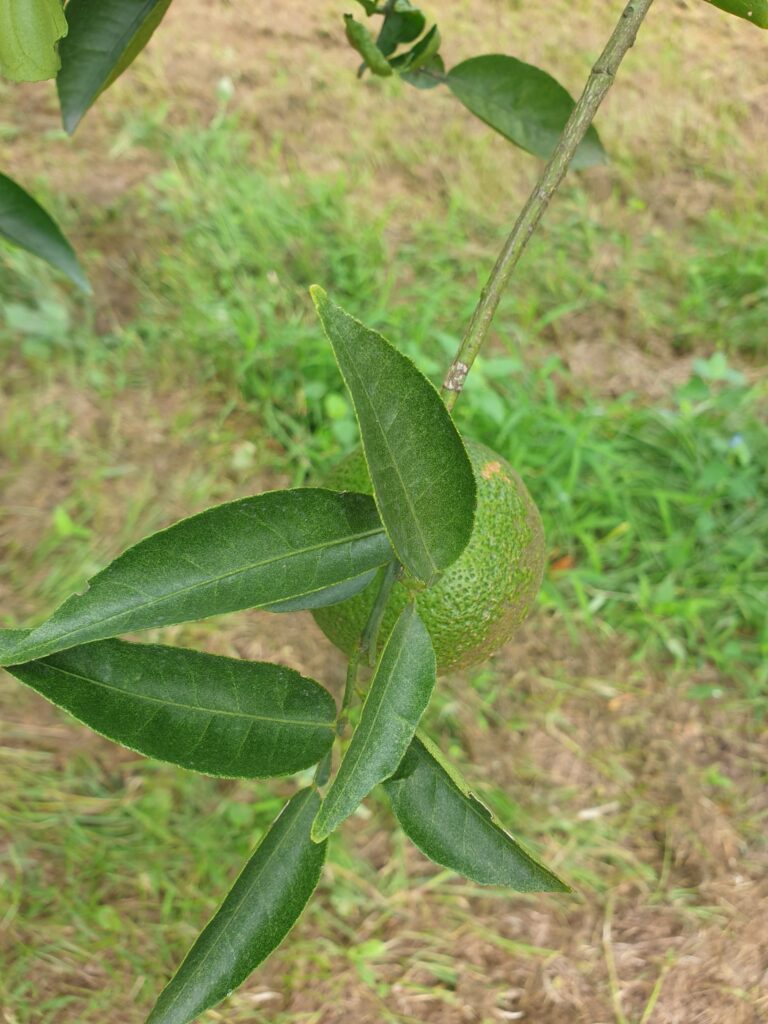
Hebesu is a medium-vigour citrus shrub or small tree, comparable in habit and growth to kabosu and jabara. Fruits ripen in greenhouse cultivation from June, and in outdoor conditions from late July to October depending on the locality (Hyūga City, 2020).
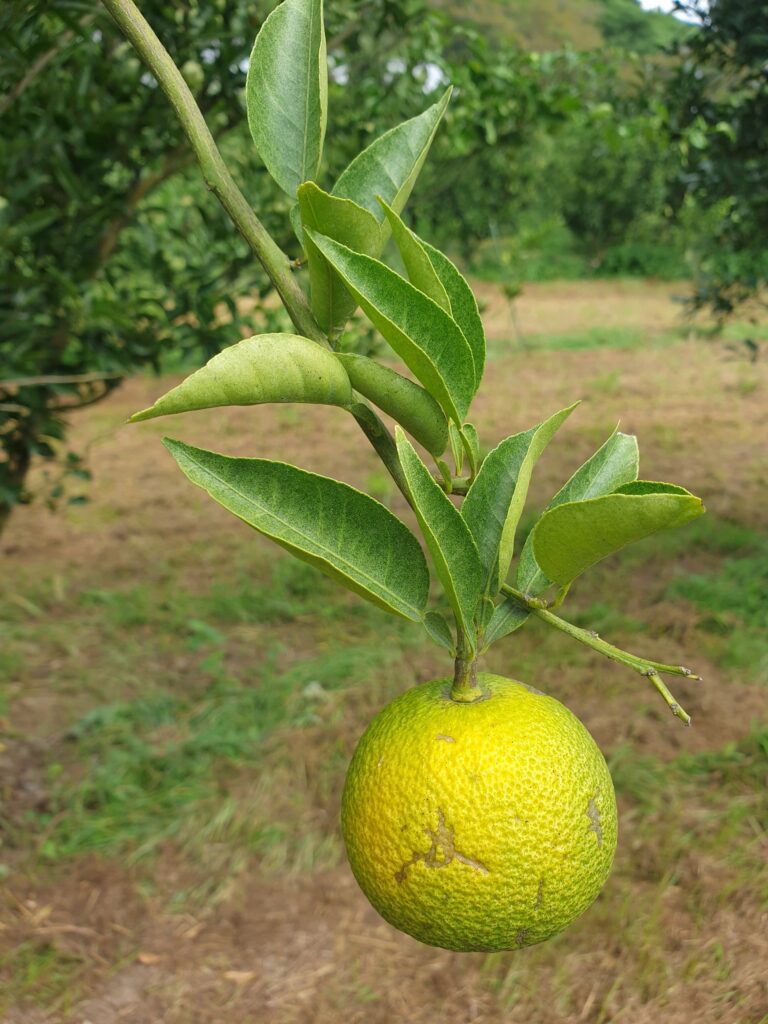
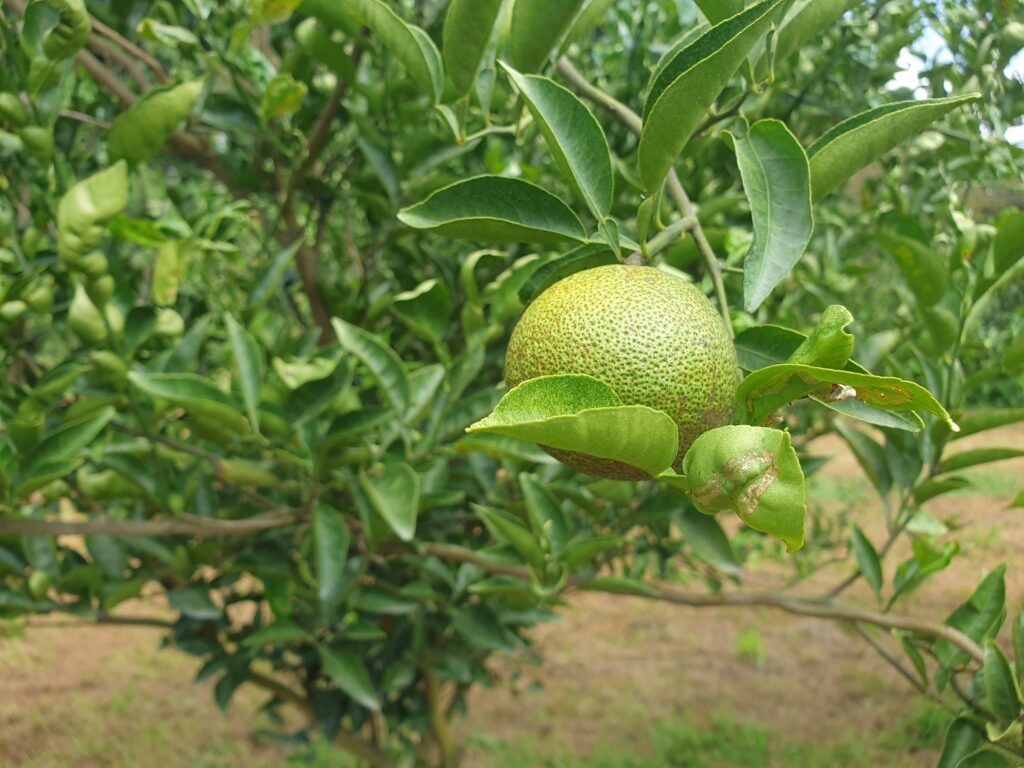
The fruit is small and greenish — typically harvested at the green stage, yellowing on full ripening. Its distinguishing features are a thin rind and low seed count, which make the fruit easy to squeeze and yield an above-average volume of juice (Hyūga City, 2020)
. The fruit is larger than sudachi (C. sudachi Shirai ex Tanaka) but smaller than kabosu (C. sphaerocarpa Tanaka). The flesh is markedly juicy; juice yield is reported as above average compared with other Japanese sour citrus fruits (Adhikari-Devkota et al., 2019).
FLAVOUR AND USES
Hebesu juice is distinctly acidic, yet markedly milder and aromatically more complex than lemon or lime — with a hint of sweetness and a fresh, lightly herbal undertone (Hyūga City, 2020). Trade descriptions note tasting notes reminiscent of lemon, pineapple and kaffir lime leaf (The Kokoro World, 2023). Compared with kabosu and sudachi, the flavour of Hebesu is considered less sharp and more approachable for direct consumption.
Hebesu occupies in the culinary tradition of the Hyūga region the same role that yuzu or kabosu hold elsewhere in Japan: it is used to season fish, sashimi, hot pots (nabemono), soups, sauces and rice dishes. Fresh juice is added at the end of cooking or directly at the table (Hyūga City, 2020). Unlike yuzu, whose highly aromatic rind is prized in Japanese cuisine as much as its juice, the primary product of Hebesu is the juice itself — available in greater quantity thanks to the thinner rind.
A range of processed products is made from Hebesu in Miyazaki Prefecture: liqueur (Hebesu chūhai), rice spirit with Hebesu, Hebesu salt, jams and condiments. The cultivar has entered international distribution through these products — Hebesu liqueur is available in Australia, Singapore and other markets (The Kokoro World, 2023).
PHYTOCHEMISTRY
Hebesu fruits are rich in vitamin C and citric acid (Hyūga City, 2020). Polymethoxylated flavones (PMFs), notably nobiletin and tangeretin, are present in Hebesu at levels comparable to other Japanese sour citrus fruits (Yamamoto et al., 2019); nobiletin and tangeretin are well known for their antioxidant, anti-inflammatory and anti-tumour properties. Adhikari-Devkota et al. (2019) conducted the first detailed analysis of the chemical composition and anti-neuroinflammatory activity of extracts from immature Hebesu fruit peel. The authors also note potential neuroprotective applications of fruit extracts in neurodegenerative diseases.
CONSERVATION AND CURRENT STATUS
In Japan
Hebesu is traditionally grown in the Hyūga area of Miyazaki Prefecture, where it forms part of a living agricultural and food culture. Cultivation takes place both in greenhouses (harvest from June) and outdoors (July–October) (Hyūga City, 2020). The cultivar is widespread in private gardens and small family farms. In recent decades Hebesu has attracted growing consumer interest as a regional speciality of Miyazaki Prefecture.
A collection specimen of Hebesu is maintained at the Toso Orchard (唐漿果樹園
) of the Faculty of Agriculture, Kagoshima University (Yamamoto et al., 2005).
The cultivar is not listed as threatened; its cultivation base in Miyazaki Prefecture is stable, though geographically confined to the Hyūga area and adjacent regions of Kyūshū. Nationwide spread of the cultivar beyond Miyazaki is slower than for globally promoted Japanese citrus such as yuzu or sudachi.
Outside Japan
In the international context Hebesu is present primarily as a spirits product — Hebesu liqueur is distributed in Australia and South-East Asia (The Kokoro World, 2023). The Spanish Todolicitrus Foundation (Todolicitrus Fundació) has included Hebesu among the Japanese cultivars planned for introduction into its collection as part of a citrus biodiversity conservation project (Todolicitrus, 2025). The number of Hebesu trees cultivated outside Japan remains small.