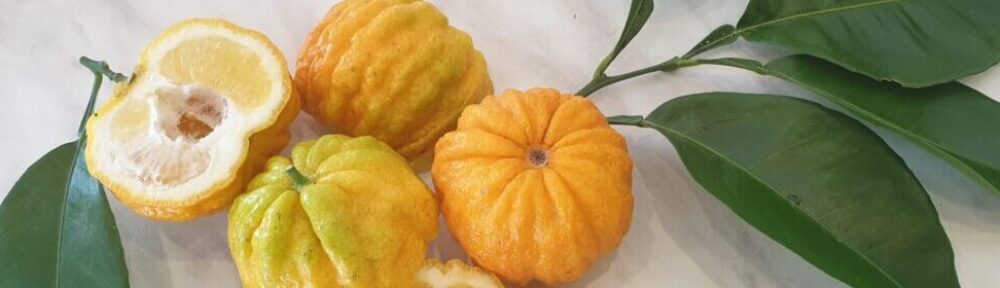
Japanese name: シィクー / シークー (Shiiku); a dialect name from Kikai Island (Shima-guchi language, 島口)
English name: Kikai sour citrus (unofficial; no standardised English name has been assigned to this taxon)
SYNONYMS
– Kusa (クサ) Hort. — local name on Amami-Oshima Island
– Tunugekunin (トゥヌゲクニン) Hort. — local name on Tokunoshima Island
TAXONOMIC NOTE
Shiiku is the local dialect name for a formally undescribed citrus cultivar grown primarily on Kikai Island (喜界島) in the Amami archipelago, Kagoshima Prefecture. The taxon is consistently classified in the scientific literature as Citrus sp., without assignment to any formally described species. Its most distinctive characteristic is the bergamot-like aroma of its fruit.
GENETIC BACKGROUND
Tanaka did not record or describe this taxon in any of his monographs.. Yamamoto et al. (2006), in their systematic survey of the Amami archipelago, explicitly noted that Shiiku belongs among taxa of “unknown scientific name and unclear taxonomic position.” Based on morphological comparison, they tentatively placed it in the group allied to sour orange (C. aurantium), without genetic confirmation.
Teramoto et al. (2017) carried out a SRAP analysis encompassing 16 cultivars and demonstrated the following: Shiiku, Kusa (Amami-Oshima) and Tunugekunin (Tokunoshima) are genetically indistinguishable and represent a single taxon. The closest genetic relatives of Shiiku are C. rokugatsu and C. depressa (Shiikuwasha); by contrast, bergamot (C. bergamia) is genetically very distant from Shiiku and the two taxa arose independently. The morphologically proposed affinity with sour orange (C. aurantium) was not confirmed as a direct parental relationship by the SRAP analysis, although Teramoto et al. (2017) do not exclude it.
A fundamentally new dimension for interpreting these results is provided by Wu et al. (2021), who used comparative genomics of 69 East Asian genomes to demonstrate the existence of a previously undescribed wild species — Citrus ryukyuensis sp. nov. — as the endemic ancestor of Ryukyuan citrus. Wu et al. (2021) further showed that C. depressa (Shiikuwasha) is a hybrid species combining C. ryukyuensis and a mainland mandarin, and that C. rokugatsu (Fusu) is a hybrid of C. ryukyuensis × C. aurantium (sour orange), with C. ryukyuensis as the seed parent and sour orange as the pollen parent.
BSince both of Shiiku’s closest genetic relatives according to the SRAP analysis — C. rokugatsu and C. depressa — share C. ryukyuensis as a parental lineage, the parsimonious hypothesis is that Shiiku likewise carries a C. ryukyuensis component in its genome. The involvement of sour orange (C. aurantium) — which Shiiku’s morphology suggests — could follow the same route as in C. rokugatsu, i.e., as the second parental species alongside C. ryukyuensis. This scenario would also provide a mechanistic explanation for the bergamot character of Shiiku’s essential oil: bergamot (C. bergamia) is itself considered a hybrid with sour orange, involvement, and if a sour orange component is also present in Shiiku’s genome, the shared biochemical basis of the aromatic compounds would be genotypically conditioned — attributable to shared genealogical origin rather than mere convergence. This hypothesis remains unverified — Shiiku has not yet been included in any global citrus genomic study — and is explicitly presented as a reasoned hypothesis, not a confirmed conclusion.
Yamamoto et al. (2019) classify Shiiku within the “sour orange relatives” group (alongside C. Rokugatsu), consistent with the findings of Teramoto et al. (2017).
The name Shiiku (シィクー) is etymologically entirely independent of the Okinawan Shiikuwasha (C. depressa Hayata). Yamamoto et al. (2010) confirmed that C. depressa does not occur as a naturalised taxon on Kikai Island. The geographic range of the Shiiku type is confined exclusively to the northern part of the Amami archipelago (Teramoto, 2017).
HISTORY AND ORIGIN
Kikai Island and its citrus tradition
Kikai Island is a raised coral reef island in the Amami archipelago, approximately 10 km east of Amami-Oshima, administratively part of Kagoshima Prefecture. The island, with a circumference of 48.6 km and an area of 56.93 km², lies on the boundary of the Eurasian and Philippine tectonic plates and rises slightly each year. The island’s subtropical climate, geographical isolation, and uninterrupted tradition of small family farms have created conditions for the preservation of local citrus cultivars.
The citrus diversity of Kikai Island is exceptional within the 1,200 km-long southwestern island chain: it is characterised by the presence of the endemic C. keraji and the cultivar C. sp. Shiiku, by the widespread occurrence of C. rokugatsu (Fusu) — now retreating elsewhere — and conversely by the absence of naturalised C. depressa (Shiikuwasha), which is common on the other islands of the archipelago (Teramoto, 2017).
This distribution is understandable in light of Wu et al. (2021) : both C. depressa and C. rokugatsu are hybrid species carrying a C. ryukyuensis component, which became established on different islands through different hybridisation events. The absence of naturalised C. depressa on Kikai Island does not preclude the possibility that an ancestor sharing the C. ryukyuensis component may have been involved in the origin of Shiiku — merely in a different hybrid combination.
First scientific documentation
Shiiku was never recorded in the historical citrus literature as a named taxon. The bergamot-like aroma of Shiiku was first mentioned by Ishihata et al. (1997) and Kita et al. (2013). Systematic scientific documentation comes from surveys Yamamoto et al. (2006), who conducted a survey of citrus genetic resources across eight islands of the Amami archipelago between 1999 and 2004.
Yamamoto et al. (2006) recorded Shiiku on Kikai Island at four localities: Kikai-cho Hawari, Kikai-cho Satedeku, Kikai-cho Kawane, and Kikai-cho Urahara. The bergamot-like fragrance of both the fruit and the leaves was recorded as the key distinguishing feature of the taxon. Based on morphological observation, the taxon was tentatively assigned to the group allied to sour orange; the scientific name was noted as unconfirmed.
A taxon related to Shiiku was also recorded on Amami-Oshima under the local name Kusa (クサ) (Yamamoto, 2006). Teramoto et al. (2017) and Yamamoto et al. (2011) They confirmed this identification through molecular analyses.
BOTANICAL DESCRIPTION
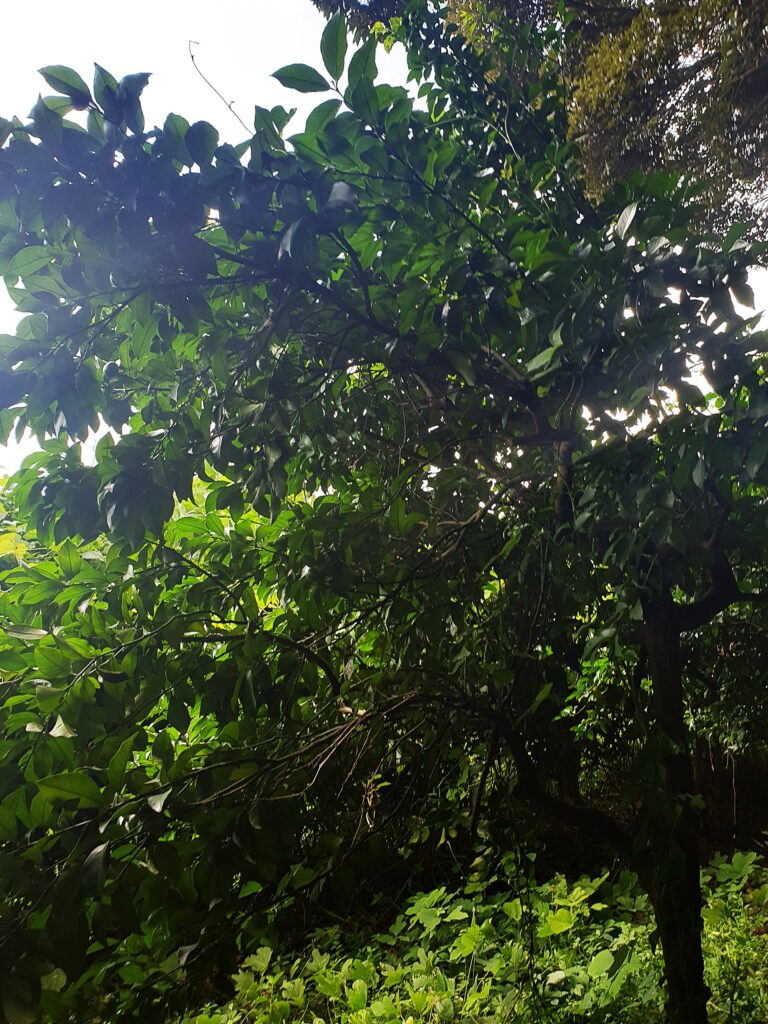
Teramoto et al. (2017) carried out morphological measurements of the Shiiku collection tree and a bergamot tree at Toso Orchard on 7 January 2016. The Shiiku tree is characterised by a vigorous habit, prolific growth, and excellent productivity; its resistance to pests and diseases in the conditions of Kikai Island is demonstrably superior to that of bergamot. Spontaneous germination from fallen seeds has been observed on the island (Teramoto, 2017).
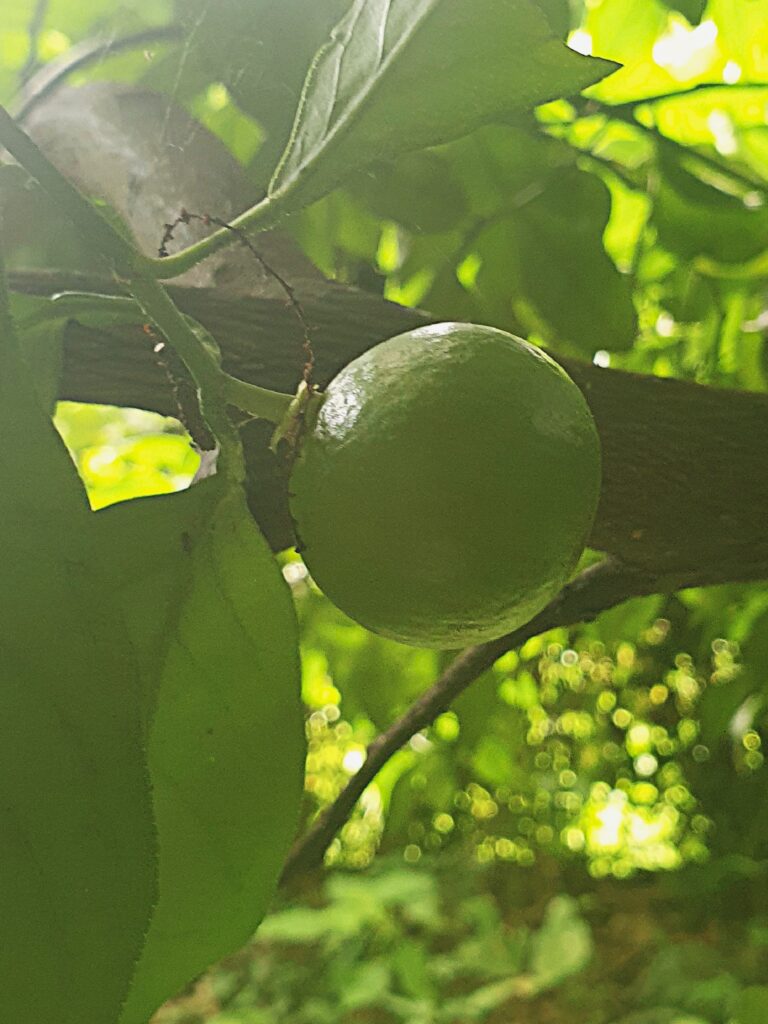
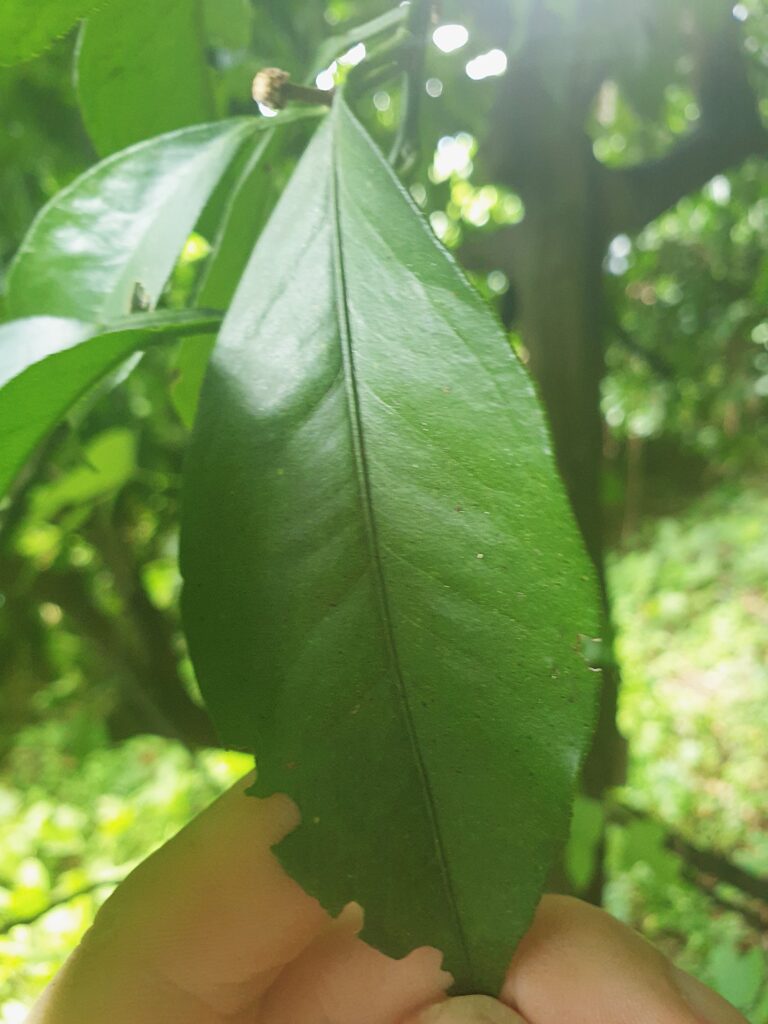
The leaves have an elliptic-lanceolate blade approximately 100 mm in length. The fruits ripen late — from January on Kikai Island — and are small, round to slightly oblate, with yellow skin and a smooth surface. Fruit weight is approximately 70 g, the number of segments 10–11, and the seeds (11–12 per fruit) are pale green and polyembryonic. Peeling is difficult (Yamamoto, 2019).
ESSENTIAL OIL AND AROMATIC PROFILE
Teramoto et al. (2017) carried out the most detailed analysis of Shiiku essential oil by GC-MS, comparing immature and mature Shiiku fruit with bergamot and Tanaka bergamot (C. balotina Poit. et Turp.) Hamada et al. (2017) analysed the essential oils of five Kikai Island cultivars; both sets of results are consistent.
IIn all three cultivars compared (Shiiku, bergamot, and Tanaka bergamot), linalool, linalyl acetate, and d-limonene together account for 77–91% of the total essential oil — these three components are identified as the fundamental aromatic triad of bergamot fragrance. The key diagnostic parameter is the linalool/linalyl acetate ratio: in Italian bergamot on various rootstocks this value ranges from 0.34 to 0.39; in mature Shiiku it is 0.36 — a practically identical value (Teramoto, 2017). The fundamental aromatic quality of Shiiku and bergamot is therefore the same, despite the two taxa having arisen independently.
Furanocoumarins and phototoxicity
In immature bergamot, the total content of furanocoumarins is 1.29% (bergapten, citropten). In immature Shiiku, bergapten was detected at only 0.05%; in mature Shiiku fruit, no furanocoumarins were detected at all. Shiiku therefore does not exhibit the phototoxic properties associated with bergamot, and its essential oil can be used directly without supplementary processing — a significant advantage over bergamot (Teramoto, 2017).
TASTE AND USE
Shiiku is valued in the traditional cuisine of Kikai Island for its intensely aromatic peel and markedly acid flesh. The juice is used to season fish, seafood, and rice dishes. The fruit is not intended for direct consumption due to its high acidity (2.8% citric acid) and low sugar content (Brix 9.5); its flavour is rated as less pleasant than that of other local cultivars (Teramoto, 2017).
The cultivar serves on the island as a local substitute for bergamot (C. bergamia). According to a personal communication from Prof. Masashi Yamamoto (Faculty of Agriculture, Kagoshima University, 2025), true bergamot cannot be cultivated on Kikai Island due to its susceptibility to fungal diseases and poor adaptation to the island’s high humidity; Shiiku has therefore naturally taken on bergamot’s culinary and aromatic role. The absence of furanocoumarins allows direct use of the essential oil without supplementary distillation, making Shiiku technologically superior to bergamot in this respect (Teramoto, 2017).
Teramoto et al. (2017) also highlight the potential for extracting volatile compounds from branches and leaves (petitgrain) and from flowers (neroli), by analogy with the ways bergamot is utilised in Italy. Yamamoto et al. (2019) note the development of local processed products derived from Shiiku peel and list Shiiku among the key cultivars supporting chiiki-okoshi (regional economic and cultural revitalisation) in Kagoshima Prefecture.
CONSERVATION AND CURRENT STATUS
In Japan
Shiiku survives in private gardens on Kikai Island. Spontaneous germination from fallen seeds has been observed on the island (Teramoto, 2017) demonstrating good adaptability. The genetically identical cultivars Kusa (Amami-Oshima) and Tunugekunin (Tokunoshima) document the distribution of Shiiku across the northern part of the Amami archipelago.
Collection specimens are maintained at Toso Orchard (唐湊果樹園) of the Experimental Farm, Faculty of Agriculture, Kagoshima University: accession 30 (Kikai Island, received February 2003), accession 31 (Amami-Oshima), and accession 32 (Yamamoto, 2006, 2019).
In Europe
Citrus sp. ‘Shiiku’ is not documented in any European collection or in commercial cultivation.