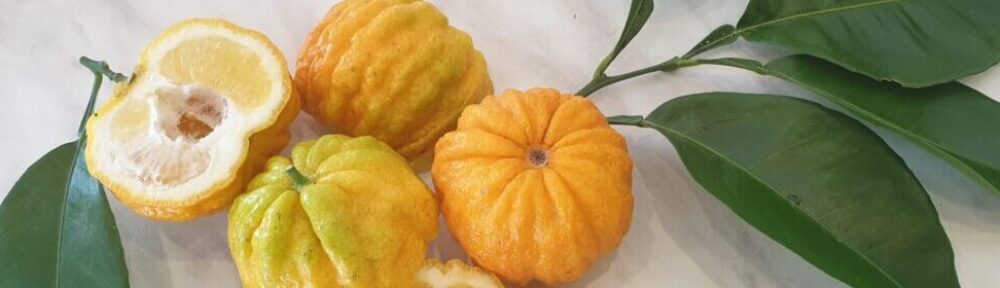
Japanese name: 紀州蜜柑 (Kishū-mikan)
English name: Kishu mikan, Kishu mandarin, Cherry orange, Baby mandarin
Regional name (Kagoshima): 桜島小みかん (Sakurajima komikan) — literally “small mandarin of Sakurajima”
Chinese name: 南丰蜜橘 (Nanfengmiju), pronounced “nán-fēng-mì-jú” — literally “honey mandarin of Nanfeng”
European nursery name: Honikan
SYNONYMS
— Citrus nobilis Lour. var. kinokuni Hayata — older botanical classification
— Sakurajima-mikan Hort. ex Tanaka — regional cultivar from Kagoshima (Tanaka, 1946, č. 142)
— Sangatsu-mikan, Takada-mikan, Ma-mikan, Kawachi-mikan, Higo-mikan, Izumi-mikan — local Japanese synonyms recorded by Tanaka (Tanaka, 1946)
— Mukakukishu (無核紀州) — seedless form: Citrus kinokuni f. mukaku-mikan Tanaka 1946 (Tanaka, 1946, č. 143)
— Kira kishu — larger variety, rarely with seeds (UCR, CRC 696, 2026)
— Nanfengmiju (南丰蜜橘) — Chinese form, genotypically identical to Kishu mikan (Shimizu et al., 2016)
— Hon mikan (本蜜柑, “true mandarin”) — historical Japanese synonym for Kishu mikan during the period of its market dominance, approximately until the mid-Meiji era (Japanese Wiki Corpus)
— Honikan — European nursery name, most likely derived from the Japanese “hon mikan” through phonological compression in oral tradition (see Conservation section below)
Nomenclatural note: The Chinese form Nanfengmiju is designated in the botanical literature as Citrus reticulata Blanco cv. Kinokuni (Chaisiri et al., 2021).
HISTORY AND ORIGIN
Origin in Southern China and the Tribute System
Citrus kinokuni is one of the oldest citrus crops known. The fruit originates from southern China, where it has been cultivated for at least since the 8th century AD (Deng et al., 2020; Karp, 2010). A related seeded variety called Ruju was offered as a tribute crop to the Song dynasty in 1060 and was at that time considered the finest mandarin cultivar of all (Karp, 2010). The cultivar name is recorded in administrative documents from Jianchang County dating to the Ming dynasty, and cultivation was widespread in Jiangxi Province (Deng et al., 2020). In the Chinese tribute system, a compulsory portion of the mandarin harvest was delivered to the imperial court; this was not an exclusive monopoly, but a feudal tax obligation — growers were free to sell the remainder of their produce (Karp, 2010).
Genomic studies have shown that Kishu mikan is closely related to the Huanglingmiao mandarin — both share the same introgression from pummelo (Citrus maxima), suggesting a common hybrid ancestor (Wu et al., 2018). The proportion of mandarin genome reaches approximately 99.3%, with no significant pummelo admixture (Shimizu et al., 2016).
Introduction to Japan and Wakayama
The cultivar was most likely introduced to Japan around the 12th–13th century through trade contacts with China (Deng et al., 2020). It took root particularly in Kii Province (紀伊国, Kii no kuni), present-day Wakayama Prefecture, where it became the principal commercial citrus crop. Both the Japanese name 紀州 (Kishū, “the province of Kii”) and the Latin epithet kinokuni derive from this province. The area around the city of Arida (有田市) became the centre of cultivation, with the Kishū Tokugawa family, a collateral branch of the Tokugawa clan, playing an active role in extending orchards onto steep hillsides unsuitable for rice paddies (Karp, 2010).
Kishu mikan dominated the Japanese citrus market from the Edo period (1603–1868) through the Meiji era. The merchant Kinokuniya Bunzaemon (1669–1734) amassed a fortune shipping the fruit to Edo (present-day Tokyo). Its commercial decline came only in the Meiji era, when it was displaced by the larger and more productive satsuma mandarin cultivars (Tanaka, 1946; Karp, 2010).
The Superstition of Infertility and the Cultural Symbolism of Seeds
A key factor in the sustained popularity of Kishu mikan throughout the Edo period was that its fruit contained seeds. In Japanese folk culture of the 17th–19th centuries, there was a widespread belief that eating seedless fruit caused infertility — seeds symbolised offspring and the continuation of the family line. Seedless fruit, such as unshiu mikan (satsuma), was therefore regarded as a bad omen that could bring about the extinction of the family line. Conversely, seeded Kishu mikan was positively associated with fertility, prosperity, and healthy offspring (Deng et al., 2020; Karp, 2010).
This superstition persisted into the Meiji era (i.e. around the turn of the 19th and 20th centuries) and in effect acted as a natural protection for the market position of Kishu mikan. Ironically, the same belief simultaneously slowed the spread of the seedless form Mukakukishu — even today some Japanese families prefer the seeded cultivar, while in the American market it is the seedless Mukakukishu that dominates as the more convenient table form (Karp, 2010).
Sakurajima Komikan — A Regional Cultivar in Kagoshima
A special case within the species Citrus kinokuni is Sakurajima komikan (桜島小みかん), grown on the volcanic peninsula of Sakurajima in Kinko Bay, Kagoshima Prefecture. It is a clone of Kishu mikan adapted to local volcanic conditions. Historical records attest to the cultivation of komikan on Sakurajima throughout the Edo period; in 1603, Lord Shimazu Tadatsune presented them to the Shogun Tokugawa Ieyasu as a tribute to the exceptional flavour of the fruit (Japan GI, 2023). The original name for these fruits was “Mukoujima mikan” or “Aka mikan”, and the name “Sakurajima mikan” became established around 1658.
Scientific Classification and Taxonomy
Tyōzaburō Tanaka described the taxon under the name Citrus kinokuni Hort. ex Tanaka in 1911, and in his monograph Nihon Kankitsu Zufu (An Iconograph of Japanese Citrus Fruits, 1946) he devoted entry no. 142 to it, including a detailed botanical illustration, data tables, and a description. The seedless form is described under no. 143 as Mukaku-kishū (C. kinokuni f. mukaku-mikan). In Swingle’s classification, the taxon is treated as a cultivar of Citrus reticulata (Tanaka, 1946).
Genetic Characteristics
Genomic studies have demonstrated that Kishu mikan is a nearly pure cultivar of Citrus reticulata (mandarin genome proportion ~99.3%), without significant introgression from pummelo (Shimizu et al., 2016; Wu et al., 2018). DNA analyses revealed exceptionally low genetic diversity: 16 accessions examined from two countries show virtually identical genotypes, a consequence of centuries of vegetative propagation by grafting. Genetic markers associated with seedlessness in the Mukakukishu form were identified by bulked segregant analysis (Chavez & Chaparro, 2011). Kishu mikan is also the maternal parent (seed parent) of Citrus unshiu (satsuma mandarin), which arose through hybridisation with Kunembo (Citrus nobilis var. kunep) — a relationship confirmed by Japanese genetic studies and cited by the Japanese Ministry of Agriculture (Yamamoto et al., 2022).
BOTANICAL DESCRIPTION
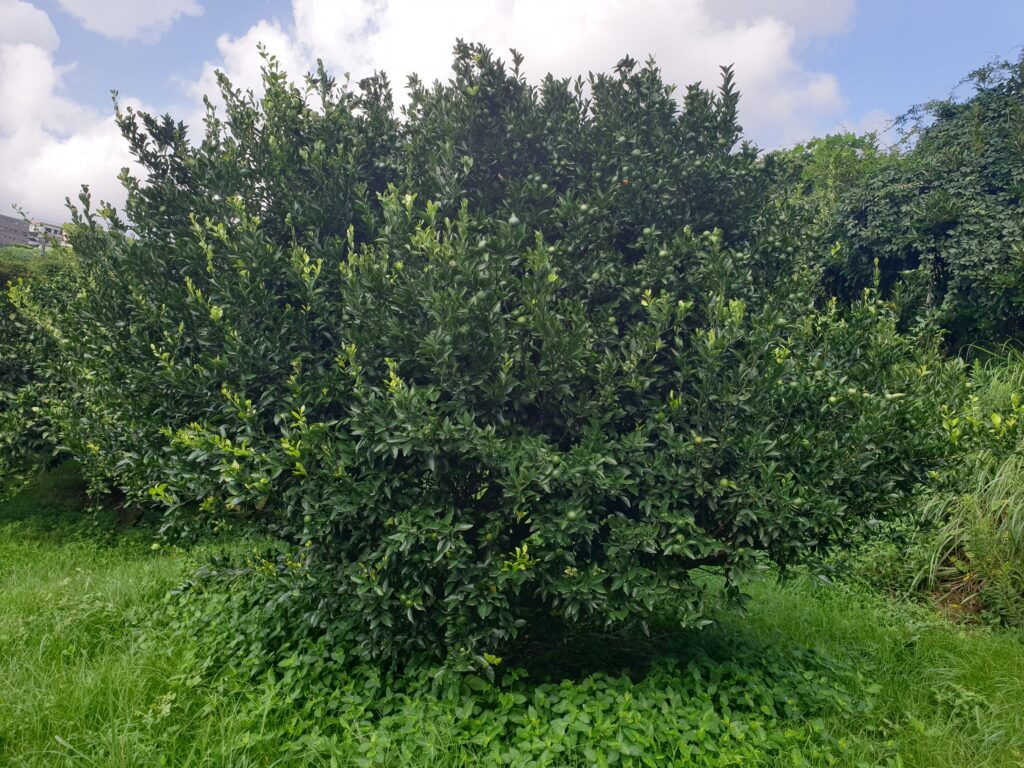
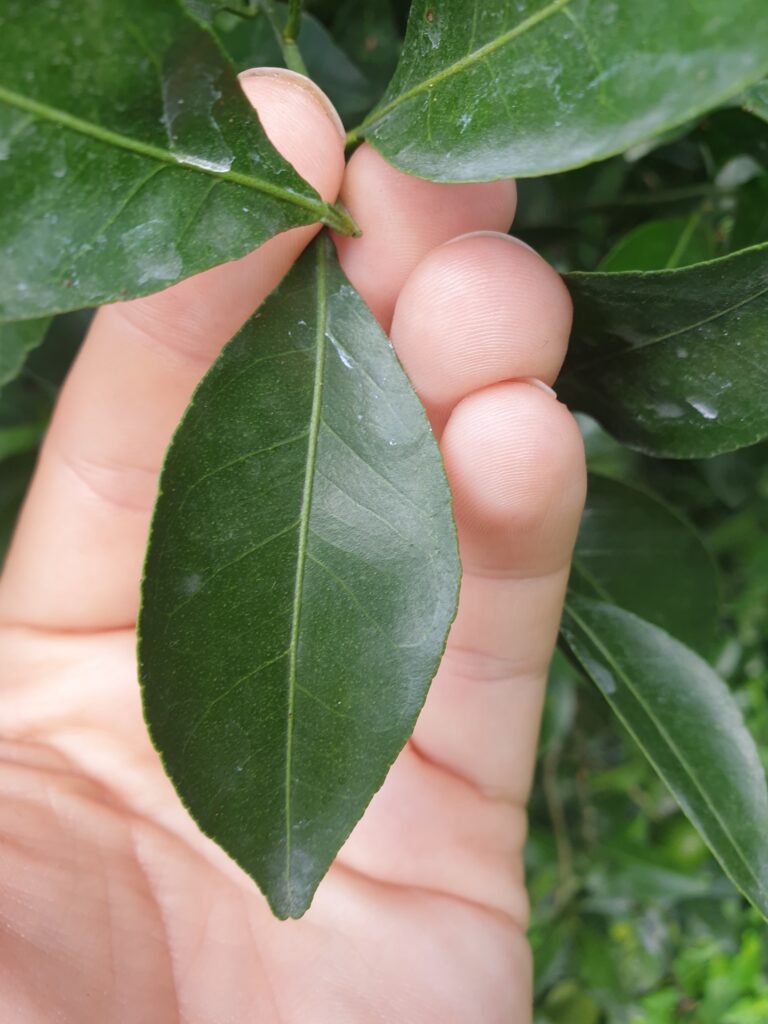
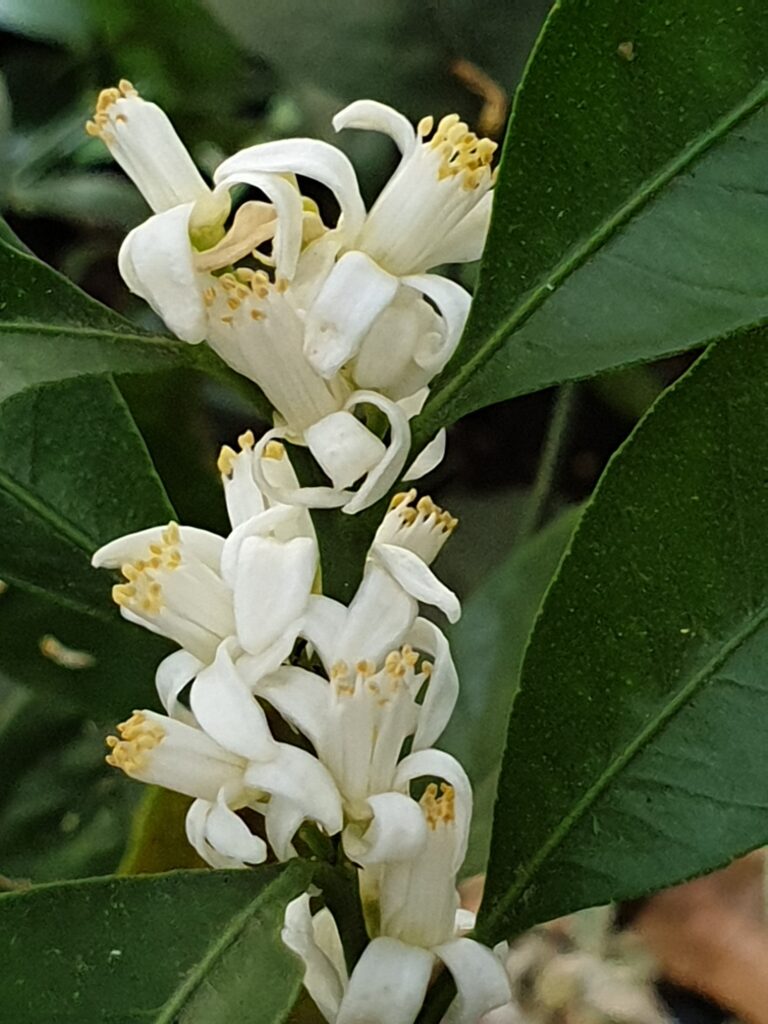
The tree is of small to medium stature, typically reaching 2–3 metres in height; the UCR Citrus Variety Collection describes it as a dwarf evergreen shrub (UCR, CRC 696). On Sakurajima, specimens over 200 years old have been recorded. Leaves are medium-sized, narrowly elliptic, with minimal wings on the petiole. Flowers are white and fragrant.
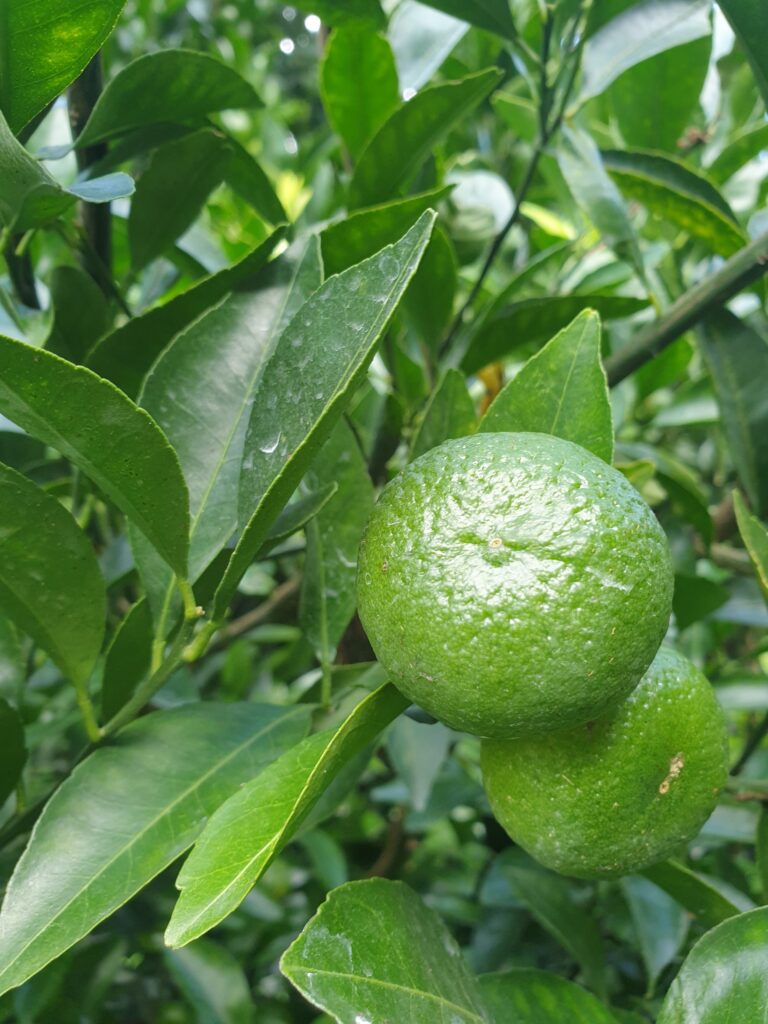
Fruits are small, globose to slightly oblate in shape, depressed at both poles. Data from Tanaka’s monograph (records from 1938–1939) give a diameter of 3.4–4.9 cm, height of 4.8–5.9 cm, and weight of 50–66.5 g (Tanaka, 1946). Sakurajima komikan is cited as the smallest Japanese mandarin: 4–5 cm in diameter and 20–50 g in weight (Japan GI, 2023). The peel is thin (approximately 0.9–1.0 mm), adherent, easy to peel, and intensely aromatic. The surface is glossy and, at full maturity, deep orange. The flesh is firm, juicy, pleasantly sweet with a refreshing acidity (UCR, CRC 696, 2026; Tanaka, 1946).
Seed count: the standard form bears a small number of polyembryonic seeds with pale green cotyledons; the seedless form Mukakukishu is entirely seed-free (Tanaka, 1946, č. 143; Chavez & Chaparro, 2011). Segment count: 10–11. Ripening: in Japan from November to February depending on location (Sakurajima: harvest from mid-November to the end of December) (Japan GI, 2023).
FLAVOUR AND USES
Kishu mikan is among the sweetest citrus fruits — sugar content exceeds 8.5% (typically 11–14 Brix) and acid content is below 1.0% (Japan GI, 2023; Minneopa Orchards, 2022). The UCR Citrus Variety Collection describes it as “firm, meaty, pleasantly sweet” (UCR, CRC 696, 2026). The peel is intensely aromatic; dried peel is traditionally ground as a spice ingredient in the Japanese seasoning blend shichimi togarashi (Minneopa Orchards, 2022). Thanks to the thin peel and typical seedlessness, the cultivar is ideal for fresh consumption — small fruits can be eaten whole in a single bite.
In Japan, Kishu mikan is traditionally consumed during the winter season; Sakurajima komikan is an integral part of New Year decorations (shimenawa, kagami-mochi), where the mandarin symbolises prosperity and family wellbeing (Japan GI, 2023).
CONSERVATION AND CURRENT STATUS
In China — Nanfengmiju as the Chinese Form of Kishu Mikan
In China, Citrus kinokuni is still cultivated today under the local name Nanfengmiju (南丰蜜橘, literally “honey mandarin of Nanfeng”). Genetic analyses have confirmed that Nanfengmiju and Kishu mikan are genotypically identical cultivars (Shimizu et al., 2016; Karp, 2010). Nanfengmiju has been grown in Nanfeng County, Jiangxi Province, for over 1,300 years without interruption and is among the most widely cultivated mandarin varieties in all of China (Chaisiri et al., 2021; USDA Citrus Annual, 2024). In the botanical literature it is designated Citrus reticulata Blanco cv. Kinokuni (Chaisiri et al., 2021).
The primary production region remains Nanfeng County (Jiangxi), though Nanfengmiju is also grown in Yunnan Province (USDA Citrus Annual, 2024). Since around 2015, Nanfengmiju has faced market pressure: falling prices caused by oversupply, inconsistent quality, and increasing competition from hybrid cultivars have led to a decline in commercial interest (Citrus Industry, 2024). In response, Chinese agricultural universities have launched breeding programmes. A new variety, Guiyuehong (桂月红), bred from an early-ripening mutation of Nanfengmiju by Huazhong Agricultural University in collaboration with local growers, received official registration from the Chinese Ministry of Agriculture in 2022 (Citrus Industry, 2024). Guiyuehong ripens approximately six weeks earlier than standard Nanfengmiju and shows stable sugar content, thereby extending the commercial harvest window.
In Japan — Wakayama and the Surrounding Region
The historical centre of cultivation is the Arida area in Wakayama Prefecture. Following the mass adoption of satsuma mandarins, commercial interest declined; nevertheless, Kishu mikan has survived in traditional gardens and specialist orchards. Trees are commonly grown in Japan in home gardens, under glass, and in containers on balconies (Karp, 2010; UCR, CRC 696, 2026).
Sakurajima Komikan — A Living Tradition with Protected Designation of Origin
Sakurajima komikan is an actively cultivated regional product. Since 1979, growers have used roof covers (installed roof) to protect the fruit from volcanic ash fall, while the sides remain open for natural ventilation. In 1983, the Sakurajima Town Agricultural Cooperative was established to set unified quality standards (Japan GI, 2023).
The product is registered in Japan’s Geographical Indication (GI) system as a protected designation of origin, guaranteeing that only fruit harvested on Sakurajima and meeting the quality standard (sugar content ≥ 8.5%, acid content ≤ 1.0%) may bear this designation (Japan GI, 2023). The harvest lasts approximately one month (mid-November to the end of December); the limited volume of production maintains a high market value and strong local cultural prestige. Several trees on Sakurajima are demonstrably over 200 years old.
Distribution and Availability in the USA
Kishu mikan was described in the USA as early as 1888 by agronomist B. M. Lelong as “one of the finest table varieties”, but was deemed too small for commercial production (Karp, 2010). In 1983, the seedless form Mukakukishu was introduced to the UCR Citrus Variety Collection from Japan (UCR, CRC 3887, 2026) and, following clearance from citrus tristeza virus, released for nursery distribution (UCR, CRC 3887, 2026; Karp, 2010). Grower Jim Churchill from Ojai Valley (Ventura County, California) was introduced to the cultivar at a UCR event led by Ottillia Bier in 2000 and became the first to plant it commercially — the first harvest took place in 2004 (Karp, 2010).
Today, Churchill Orchard (tangerineman.com) grows certified organic Kishu mandarins on approximately 12 acres and operates a mail-order service during the January–February season. In addition to commercial orchards, Kishu mikan trees are offered to home gardeners by leading American citrus nurseries, most notably Four Winds Growers (Livermore, CA), including semi-dwarf forms suitable for container growing (Four Winds Growers, 2026). The fruit is sold as a specialty item at farmers’ markets and in specialty food stores in California and Florida; the season is short and stocks typically sell out within days (Specialty Produce, 2026). The cultivar reached Europe in 2006 (Karp, 2010).
Kishu mikan is further preserved in international collections: the UCR Citrus Variety Collection (CRC 696 — seeded form; CRC 3887, CRC 3906 — Mukakukishu) and Japanese citrus gene banks, including Toso Garden in Kagoshima (UCR, CRC 696. 2026; Yamamoto et al., 2022).
Distribution in Europe — the “Honikan” Cultivar
In the countries of the former Yugoslavia and in Central European nurseries, Kishu mikan is known under the name Honikan. The historical Japanese term 本蜜柑 (hon mikan, literally “true mandarin”) was in its day the standard synonym for Kishu mikan, serving as a distinguishing designation from other citrus fruits on the Japanese market during the period of its dominance, approximately until the mid-Meiji era (Japanese Wiki Corpus). A Japanese source attests to the term with the phrase: “he was given Kishu mikan (hon mikan, namely true mikan) from Kishu.”
The cultivar was most likely introduced to Yugoslavia in 1933 as part of a consignment of 372 citrus trees dispatched from Osaka by honorary consul Ujeyama (Agroklub, 2009). The name used for the consignment probably reflected the then-current Japanese trade designation Hon mikan; through phonological compression of the two words in oral tradition and the loss of the initial syllable mi- of mikan, the form honikan emerged. Growers in the Czech Republic and Slovakia who know this cultivar from the Adavo nursery catalogue consistently report that it is morphologically indistinguishable from Kishu mikan (Tropical Fruit Forum, 2019).
No primary archival source explicitly identifying “honikan” from the Yugoslav consignment with C. kinokuni has been published; the identification presented above remains a well-supported hypothesis resting on three converging lines of evidence: the confirmed Japanese synonym hon mikan, the phonological transition, and the morphological identity of cultivated plants.