There is a theory that Unshiu mandarins, also called Wenshu in Japan, originated in China. In China, there is a local name ‘Wenzhou’ in Zhejiang province.
The first researcher on the origin of Unshiu mandarins was Dr. Chosaburo Tanaka. He made field trips to different parts of China and published in his book ‘A Study of Citrus’ that there are no ‘Wenzhou tangerines’ in China. The origin of Unshiu mandarins is described in the section ‘History of fruit tree cultivation’ in ‘Kagoshima Prefecture – Post-war history of citrus farming’. Dr. Tanaka conducted research for many years and found that the Unshiu tangerine originated in Nagashima, Izumi District, Kagoshima Prefecture (now Higashi City). He concluded that Unshiu mandarins were accidental seedlings on Nagashima Island and that they must have appeared during the “early Edo period” (17th century).
In 1936, Mr. Yasuo Okada, an engineer at the Kagoshima Prefecture Fruit Tree Experiment Station, discovered an old Unshiu tangerine tree in Higashi-Nagashima village, which he estimated to be more than 300 years old. Mr Okada noted that the tree had been grafted, so it can be assumed that there were older specimens. He thus confirmed Dr. Tanaka’s estimate of the dating of the first Unshiu plants. It was a massive tree with a trunk circumference of 180 cm and a height of 7 meters, but unfortunately it was destroyed in the Pacific War.
Originally, Unshiu mandarins were called “Nakajima Hanī Kan” or “Nagashima Hanī Kan”, depending on their place of origin (Hanī means honey). The Unshiu mandarin first appears in literature in the Nankai Baofu of 1833 as ‘Li Lin, or Wenzhou Hanī kan’. In Okamura Naoken’s ‘Keien Tachibana fu’ written in 1848, the name ‘Wenshu mandarin’ is used for the first time. This name was subsequently adopted by Meiji scholars such as Yoshio Tanaka and Sadayuki Ikeda, and then widely used, especially by the Ministry of Agriculture, and subsequently modified as ‘Unshiu mandarin’.
In 1830, P. F. von Siebold first introduced Nagashima mandarins in Europe and the United States. Subsequently, in 1876, G. R. Hall first exported Unshiu mandarin seedlings to the United States. This tree was imported from Satsuma (now in Kagoshima Prefecture) and was therefore called the Satsuma Mandarin. This name has been used in English ever since (Misaki, 1999).
Whole genome sequencing analysis confirmed that Citrus kinokuni ‘Kishu’ and Citrus nobilis „Kunembo“ are the parents of Unshiu and that Kunembo is also a descendant of Kishu. Thus, it was confirmed that the Unshiu mandarin is a backcrossed descendant of the Kishu mandarin (Shimizu, 2017).
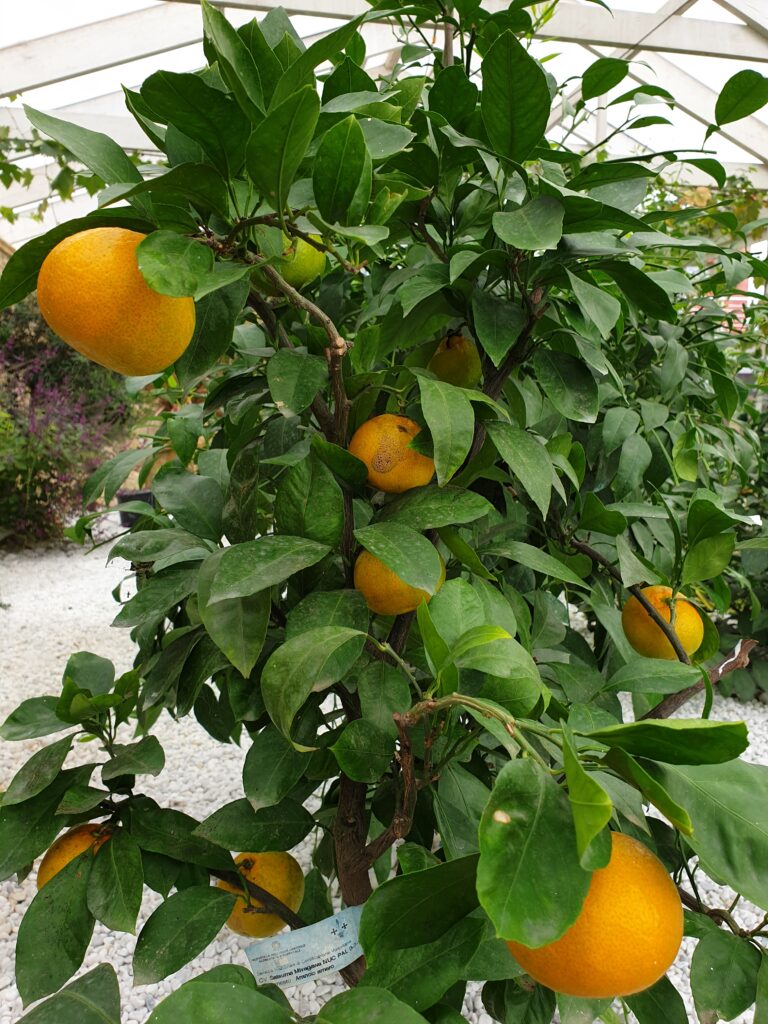
Citrus unshiu has very sweet fruits, usually without seeds, medium size, 70-120g, slightly flattened. The skin peels easily and is smooth. The fruit usually has 10 to 12 easily separable segments with tough membranes. The colour of the fruit often depends on the climate; Unshiu grown in humid, warm areas may be ripe when the skin is still green, while Unshiu grown in areas with cool night-time temperatures may have deep orange-red skin. The fruit is harvested from September to November and is usually referred to as wase, early fruit, in Japan.
Unshiu are cold tolerant and have sweeter fruit in colder locations. A mature Unshiu tree can survive down to -9 °C or even -11 °C for several hours (PLANTanswers, 2025). The trees also rarely have any thorns.
Citrus unshiu has many different cultivars. However, three of them account for almost half of the production in Japan, namely Miyagawa wase, Okitsu wase and Qingdao Wenshu (NARO, 2021).The total production of Unshiu in Japan is slightly declining, amounting to 682 thousand tonnes in 2022 (JapanCROPS, 2022). This volume represents about 74% of Japan’s mandarin production (Kurai, 2021).
The Miyagawa cultivar is commonly grown in Japan. It is a budding mutation originally from the ‘Zairai’ tree in Fukuoka Prefecture and was named and introduced by Dr. T. Tanaka in 1923. It is a prolific bloomer and usually needs fruit reduction in commercial cultivation. Therefore, it is gradually being replaced by more modern cultivars. It is seedless, with a strong flavour and medium acidity. Miyagawa fruit is slightly larger than other Unshiu (up to 130g) and also stores better. The tree is taller and has a higher yield (UCR, 2025).
The 00 mutation ripens two weeks earlier, in European conditions during September.