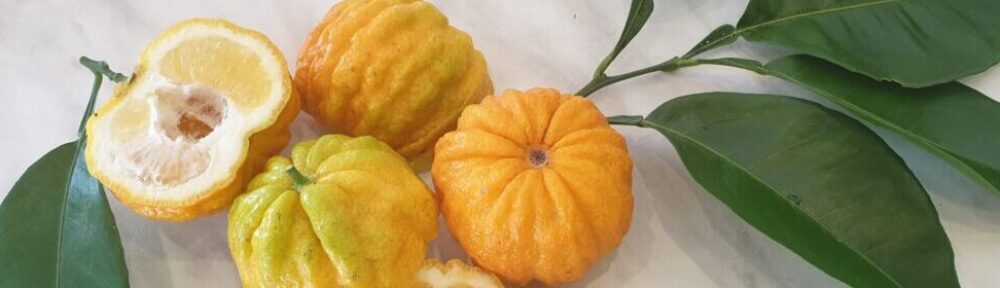
Japanese name: Hyōkan (alternative romanisation: Hyōukan; ヒョウカン / 瓲柑), read “hyōkan”; literally “gourd citrus” — from Japanese hyō (瓲, gourd) and kan (柑, citrus), referring to the characteristic flask- or gourd-shaped fruit
English name: Flask-shaped orange
Local horticultural name: Saigo Hyōkan (西郷瓢柑) — regional designation for the Kyūshū line of the cultivar, named after the Saigō-chiku district (西郷地区) of Onomichi city in Hiroshima Prefecture, from which the original scion import originated (Onda et al., 1975)
SYNONYMS
- Citrus aurantium L. subsp. intermedia Tanaka var. ampullacea Tanaka (1911) — earlier Tanaka binomen, superseded by C. ampullacea Hort. ex Tanaka (1935) as an adopted horticultural name
- Jindaikitsa Hort. (神代橘) — name recorded at the Okitsu Horticultural Experiment Station
- Kichiōka Hort. (吉樹果) — name from records in Kumamoto Prefecture
- Kichiōkan Hort. (吉樹柑) — name from the Hanada family collection in Okayama Prefecture
- Marumera Hort. (丸メラ); Shiridaka-mikan Hort. (尻高蜜柑); Tsurukan Hort. (鉤柑 / 釣柑) — further regional Japanese names without formal botanical status
Note on synonymy: All horticultural names listed above are documented by Tanaka (1946) as regional terms for the same taxon recorded at various institutions and localities in Japan and Taiwan. GBIF lists the taxon under Citrus ×ampullacea Yu.Tanaka (GBIF, 2026).
TAXONOMIC NOTE
Hyōkan belongs, within Tanaka’s taxonomic system, to the Japanese citrus cultivars formally described as Citrus ampullacea Hort. ex Tanaka (1935). Tanaka (1946) proposed this name as a novum superseding the earlier varietal combination C. aurantium subsp. intermedia var. ampullacea Tanaka (1911), suggesting affinity with the sour orange group C. aurantium. GBIF and Kew list the taxon as Citrus ×ampullacea Yu.Tanaka, where the hybrid symbol (×) reflects its presumed hybrid origin; explicit synonymy with C. aurantium is not accepted (GBIF, 2026).
The study by Shimizu et al. (2016), which analysed 101 representative Japanese citrus cultivars using 123 SSR markers and organellar genomes, placed Hyōkan (accession A035) in a genomic group characterised by the pummelo cytotype (C04 in the classification of that study). Allele-sharing analysis and single-parent probability (SPP) identified Kunembo (A081, C. nobilis Lour. var. kunep Tanaka) as the probable pollen parent with zero mismatches; the seed parent remains unidentified, with its cytotype pointing to a cultivar carrying a pummelo organellar genome. In the inferred genealogy, Hyōkan is grouped with Hassaku, Asahikan, Kaikoukan and Kinkoji, all sharing Kunembo-A as one parent (Shimizu et al., 2016). Shimizu (2022) confirmed this result, placing Hyōkan among the cultivars for which Kishu is an indirect parent via Kunembo.
A fundamental taxonomic distinction exists with respect to the related cultivar Yuge Hyōkan (Citrus yuge-hyōkan Hort. ex Y. Tanaka), which Tanaka (1946) described as a separate new species (nov. sp.) in the same volume of the monograph. The biologically most significant distinguishing character is seed embryony: Hyōkan bears exclusively monoembryonic seeds (NARO Genebank, 2026), whereas Yuge Hyōkan is described as polyembryonic (Tanaka, 1946). The two cultivars differ further in the number of flesh segments (approximately 12 in Hyōkan, 9 in Yuge Hyōkanu) and in several other morphological traits. The genomic analysis of Shimizu et al. (2016) placed the two taxa in entirely distinct genealogical contexts, confirming the validity of Tanaka’s species-level distinction.
HISTORY AND ORIGIN
Japanese tradition and horticultural documentation
Hyōkan is attested in Japan as a cultivated plant, with scattered occurrences across western Japan. Tanaka (1946) recorded a series of regional synonyms from Kumamoto and Okayama prefectures and from the Okitsu Experiment Station, indicating that the cultivar was known across various parts of western Japan during the first half of the twentieth century.
According to the chronicle of citrus horticulture in Hiroshima Prefecture, in the early Shōwa era (after 1926) a dedicated farmer from the Saigō-chiku district (西郷地区) of Onomichi city, Hiroshima Prefecture, brought back Hyōkan scions from Taiwan, thereby initiating cultivation of the cultivar in Hiroshima (Onda et al., 1975). The horticultural designation Saigo Hyōkan (西郷瓢柑) derives from this import: the cultivar bears the name of the district of the original introduction, not the name of an individual. The material subsequently spread in various directions — including to Kyūshū, where it persists chiefly in Miyazaki Prefecture under the name Saigo Hyōkan (MUJI / Minami no Sato, 2022; Onda et al., 1975).
Taiwan and the historical occurrence of the cultivar
The specimen material for Tanaka’s monograph was obtained from the Fruit Tree Garden of the Taihoku Imperial University in Taipei (臺北帝國大學果樹園), where the cultivar was grown between 1929 and 1939 (Tanaka, 1946). The presence of Hyōkan on Taiwan during the Japanese colonial period was a genuine, living horticultural presence — not merely a collection record — as evidenced both by Tanaka’s account and by the historical documentation of scion import from Taiwan to Japan (Onda et al., 1975). In the Chinese-language botanical tradition the cultivar is known as 瓢柑 (Piào gān), while the concurrently used designation 日本瓢柑 (Rì běn piào gān, “Japanese gourd citrus”) indicates that the cultivar is associated with Japan in the Chinese botanical context and may today refer more commonly to the more widespread Yuge Hyokan (MMPND, 2026). Following the end of Japanese colonial administration in 1945, active cultivation of Hyōkan on Taiwan probably ceased; the cultivar has not been identified as a currently grown taxon in available Taiwanese agricultural databases, botanical inventories or hobbyist sources. Survival of isolated trees from the Japanese era in private gardens cannot be excluded, but cannot be substantiated from available sources.
BOTANICAL DESCRIPTION
Hyōkan is a shrub or small tree reaching approximately 3 m in height, with upright branches, vigorous growth and a spreading habit. The tree shows low susceptibility to Citrus tristeza virus (NARO Genebank, 2026). Branchlets are of medium length with shorter internodes and short thorns. Leaves are medium to large, elliptic, approximately 11 cm long and 6 cm wide; the petiole wing is medium-sized, obdeltoid; the leaf blade is leathery with a slightly undulate margin (Tanaka, 1946).
The most distinctive character of the cultivar is its fruit: an obovate to pyriform shape with an elongated, narrowed base and a flattened apex, suggestive of a gourd or flask, from which both the Japanese and English names derive. Fruit length is approximately 10 cm, diameter 9.5 cm; weight ranges from 224 to 300 g (Tanaka, 1946; NARO Genebank, 2026). The rind is yellow at full maturity, thick (approximately 8 mm) and strongly adherent to the flesh; oil glands are large and sparsely distributed (NARO Genebank, 2026). The flesh is divided into approximately 12 segments, yellow in colour, with a firmer texture and a striking translucency reminiscent of grapefruit (Tanaka, 1946; MUJI / Minami no Sato, 2022).
Seeds are numerous (averaging approximately 27 per fruit) and exclusively monoembryonic (NARO Genebank, 2026) ) — a character of fundamental taxonomic significance that distinguishes Hyōkan from Yuge Hyōkan, whose seeds are polyembryonic Yuge Hyōkan (Tanaka, 1946). Pollen viability is high (approximately 94%; NARO Genebank, 2026). Harvest is late in the season; in Miyazaki, Saigo Hyōkan fruits grown under glass are harvested from approximately June (MUJI / Minami no Sato, 2022).
TASTE AND USE
Hyōkan is an acid citrus (香酸柑橘, kōsankankitsu) with pronounced acidity and low sugar content: titratable acidity in the juice is approximately 2.65%, and soluble solids approximately 9.6 °Brix (NARO Genebank, 2026). The juice is abundant; the flesh is translucent and juicy, with a mild, pleasant acidity and a fresh fragrance released on cutting (MUJI / Minami no Sato, 2022). Tanaka (1946) assessed Hyōkan as a late-maturing cultivar with sour flesh and limited commercial potential in the context of early twentieth-century Japanese agriculture; more recent harvest accounts from Miyazaki give a more favourable impression for direct consumption.
The strongly adherent rind and firmer flesh texture also make Hyōkan suitable for processing — juice extraction, jam and marmalade production. Documentation of specific culinary traditions associated exclusively with this cultivar was not found in available sources.
CONSERVATION AND THE CURRENT STATUS
Japan
Hyōkan is currently an extremely rare cultivar with a minimal cultivation base. The collection specimen formerly maintained in the Toso Orchard (東圃農園) of the Faculty of Agriculture, Kagoshima University, recorded by Yamamoto et al. (2005) no longer exists — the parent tree has been lost (Yamamoto et al., 2005; pers. comm. M. Yamamoto). NARO Genebank holds accession JP 113365, originating from Mie Prefecture, morphologically characterised at experimental stations in Nagasaki (1986) and Shizuoka (1993) (NARO Genebank, 2026). Saplings are available commercially under the designation 西郷(瓢柑)Saigo (Hyōkan) from specialist Japanese nurseries (e-green-sora, 2025) and fresh Saigo Hyōkan fruits are documented as a harvested and distributed product in Miyazaki Prefecture (MUJI / Minami no Sato, 2022). The extent of private cultivation has not been systematically surveyed.
Taiwan and the Chinese-language sphere
Hyōkan was genuinely cultivated on Taiwan during the Japanese colonial era (Tanaka, 1946; Onda et al., 1975). Following the end of Japanese administration in 1945, active cultivation on Taiwan probably ceased. The cultivar has not been identified as a currently grown taxon in available Taiwanese agricultural databases, botanical inventories or hobbyist sources under either its Japanese name (Hyōkan) or its Chinese designation 瓢柑 (Piào gān) (MMPND, 2026). Survival of isolated trees from the Japanese era in private gardens cannot be excluded but cannot be substantiated from available sources.