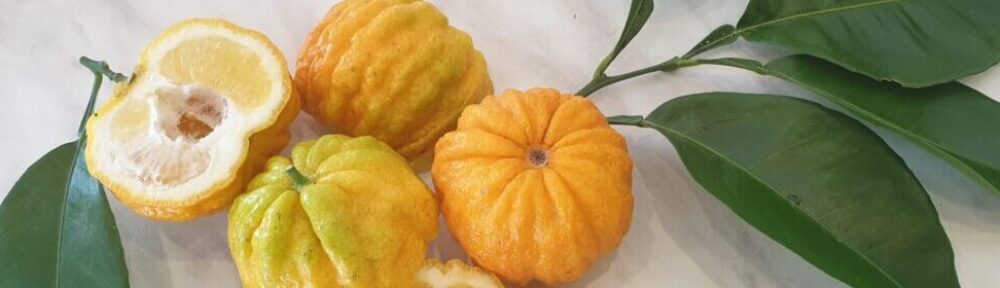
Hōraikan (宝来柑 / 蓬莱柑),”citrus from the land of Hōrai” (蓬莱 / 宝来, in Japanese mythology a luxurious island of eternal youth beyond the sea)
Ujukitsu (宇樹橘)
SYNONYMS
The taxon bears different names depending on region. In Fukuoka and Shizuoka prefectures the name Ujukitsu (宇樹橘) is attested; spelling variants 宇治金時 and 宇樹金時 also occur. In Miyazaki and Ōita prefectures the form Hōraikan (蓬莱柑 or 宝来柑) is used. In Ōita the local name Ukijukan (浮樹柑) is also recorded (Mimata et al., 1993). In Nagasaki the cultivar was historically confused with the name Bushukan (佛手柑, formerly a general term used in horticulture for many citrus cultivars; still used locally in Kochi for C. inflata, but in the literature today correctly applied only to C. medica var. sarcodactylis) — a misidentification explicitly corrected in Studia Citrologica (Tanaka Kankitsu Shikenjō, 1927).
In the English-language citrus literature the synonyms Tsurukan and the already mentioned Bushukan are encountered (UCR CRC 3467, 2026).
HISTORY AND ORIGIN
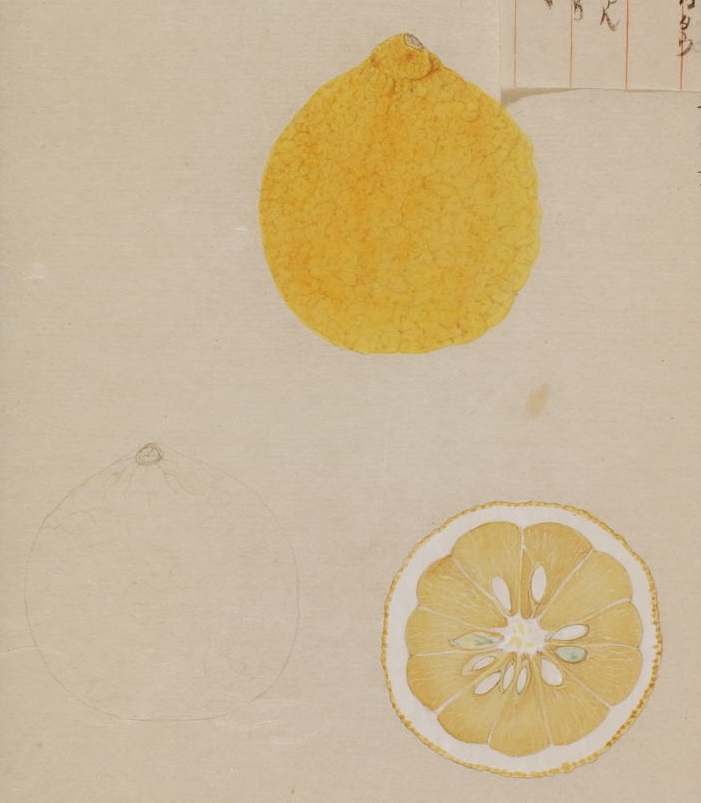
Horaikan belongs to the oldest documented Japanese citrus cultivars. The earliest surviving botanical representation is an illustrated page from the botanical atlas Shokubutsu Shūsetsu (植物集説, Tokyo National Museum, 1895), in which the cultivar is identified as Horaikan (宝来柑) originating from Bungo Province (豊後産 — present-day Ōita Prefecture). The manuscript note on the accompanying slip in the atlas records a thick peel, edible albedo, and a pronounced aroma with noticeable acidity (Iwasaki, 1885).
The earliest dateable written record attesting the cultivar in the Wakayama region is the treatise Kishu Kankitsuroku by Fukuba H., which lists Ujukitsu among thirty-three citrus varieties traditionally cultivated in the Kishū region (Fukuba, 1882; cited after Shimizu et al., 2016). A brief description of the fruit is contained in the encyclopaedia Useful Plants of Japan: “The shape of this fruit is round or pointed with a yellow skin. It is juicy, but not very sweet unless it is preserved till summer.” Dai Nihon Nōkai, 1895). The cultivar was documented by the Botanical Station of the Tanaka School in Kankitsu Kenkyū, where it is described as an erect, densely leafy tree bearing pear-shaped yellow fruits with a densely oil-glandular rind and dark-yellow, soft, well-flavoured flesh; in Nagasaki it was at that time erroneously called Bushukan (Tanaka Kankitsu Shikenjō, 1927).
A formal scientific description was prepared by Chōzaburō Tanaka in 1935 in Studia Citrologica VII: 73–74 under the binomial Citrus ujukitsu Hort. ex Tanaka. Tanaka described both regional cultivars — Hōraikan and Ujukitsu — as a single, identical taxon (Tanaka, 1935). The genomic analysis of Shimizu et al. (2016) fully confirmed this treatment: both accessions (A197 = Ujukitsu; A034 = Horaikan) are completely identical across 169 SSR markers and form an unambiguous synonymous pair (Shimizu et al., 2016).
The origin of the taxon is unclear. On the basis of allele-sharing analysis and organellar cytotypes, Shimizu et al. (2016) infer that Ujukitsu arose through natural hybridisation: Kishu mikan (C. kinokuni hort. ex Tanaka, cytotype C12 / mandarin type) was most likely the pollen parent, while the seed parent carrying cytotype C04 (pummelo type) remains unidentified. In the genomic map (PCoA, Figs 1 and 8 in Shimizu 2016), Ujukitsu is positioned close to Kishu, Naruto, and Yuge Hyōkan; the shared pummelo-type organellar cytotype C04 points to an as yet unidentified pummelo-type variety as the maternal progenitor. The hypothesis of yuzu involvement, cited in popular sources, is not supported by genomic evidence — yuzu carries cytotype C09, not C04 (Shimizu et al., 2016).
BOTANICAL DESCRIPTION
Tree
The tree is erect and densely foliated, with leaves morphologically similar to sweet orange (Tanaka Kankitsu Shikenjō, 1927; UCR CRC 3467, 2026). Neither the NIFTS collection nor the Ōita trials record thorns on bearing trees.
Fruit
The fruit is oblate-globose with a slight constriction near the peduncle; the characteristic shape is less pronounced than in the related Sanbokan or the hybrid Toyo no Takarakan (cf. photographic documentation in.Mimata et al., 1993)). Average fruit weight of authentic Japanese material from the Ōita station was 161.8 g (Mimata et al., 1993). Bitters (UCR CRC 3467, 2026) records dimensions of 6.2 cm height × 6.4 cm width, i.e. the fruit is slightly wider than tall. The colour of fully ripe fruit is orange — as unambiguously shown in the photographic documentation in Mimata et al.(1993).
The rind is thick (~4 mm (UCR CRC 3467, 2026)), with densely packed oil glands; the albedo is edible (Iwasaki, 1885). The surface is smooth, the apex flat and without an areole; the peduncle is rounded (UCR CRC 3467, 2026). The fruit contains approximately 10 segments; the segment membranes are somewhat softer than in the parent varieties (Mimata et al., 1993).
Seeds and polyembryony
Seed counts in Japanese fruits are low: Sawamura & Kusunose (1979) report an average of 5 seeds per fruit (Kōchi Prefecture material, November 1978), while Mimata et al. (1993) record ~9.6 seeds per fruit (Ōita material, February 1991). The taxon exhibits an exceptionally low rate of polyembryony: only 26% polyembryonic seeds with an average of 1.42 embryos per seed (Ueno, I., et al., 1967; cited after Mimata et al., 1993) — the lowest value recorded among the Japanese citrus cultivars surveyed. This has significant implications for the genetic identity of seed-grown progeny: see the section on the American variant.
Taste and utilization
The flavour profile of Horaikan is unusual within the context of Japanese acid citrus (酸用カンキツ). Compared with yuzu, sudachi, or kabosu it has markedly lower acidity, yet higher than typical Satsuma mandarins, together with good sugar content. The cultivar reaches its full aromatic potential only when allowed to ripen on the tree from late January through early February (Mimata et al., 1993).
Analytical data from the Ōita Citrus Experimental Station (Mimata et al., 1993) record a Brix of 12.0° and acidity of 1.16% — values representative of commercial fruit. The combination of pronounced sweetness and residual acidity produces an intense, full, and harmonious flavour rather than insipid sweetness. By contrast, the immature material sampled at the Kōchi Agricultural Experiment Station in November 1978 showed an acidity of 2.26% and total sugar of 4.83% (estimated Brix ~5.5). The low weight and sugar content in that dataset reflect fruit collected well outside the optimal harvest window. Even so, Horaikan displayed low acidity relative to typical acid citrus such as Sudachi or Kabosu. The authors therefore concluded that the cultivar is unsuitable as a citrus seasoning (katsu-okoshi), but valuable as a flavour enhancer for Satsuma mandarin juice (Sawamura & Kusunose, 1979).
The cultivar is consumed fresh and processed into juices, marmalades, and confectionery. Its ornamental shape is appreciated in Japanese and French cuisine (Mimata et al., 1993).
DISTRIBUTION AND CURRENT STATUS
Japan
Horaikan is cultivated on a small scale in Ōita, Miyazaki, Fukuoka, and Shizuoka prefectures. It is not a commercially dominant variety — a fact already noted by Bitters in 1963 (UCR CRC 3467, 2026). Within the breeding programme of Ōita Prefecture, the hybrid ‘Toyo no Takarakan’ (豊の宝柑) was registered in 1993, having been raised in 1973 at the Tsukumi branch of the Ōita Citrus Experimental Station by crossing Sanbokan (♀) × Horaikan (♂). The hybrid is characterised by a distinctive fruit shape with a pronounced collar at the peduncle, strong parthenocarpy (~80% seedless fruits), monoembryonic seeds, and a fruit weight of ~130 g; it reaches edible ripeness in December and full aroma in January–February (Mimata et al., 1993).
United States
The cultivar was introduced in 1963 by W.P. Bitters (UCR CRC 3467, 2026) as seeds from Shizuoka Prefecture — see the section on the American variant below. In Texas (Rio Grande delta), several specimens were held in the USDA Rio Farms collection during the 1980s; after the 1983 freeze a single tree survived, and John Panzarella (Angleton, TX) subsequently propagated the cultivar from budwood taken from it. In the United States it is commercially promoted as ‘Ujukitsu’ or ‘Lemonade fruit’ and grown as an ornamental and edible cultivar in warm regions (USDA zones 9a–10b). Its morphological and flavour characteristics, however, differ substantially from authentic Japanese Horaikan (see below).
American Variant (‘Ujukitsu’ UCR CRC 3467) — Note on Identity
The American material in the UCR Citrus Variety Collection (CRC 3467, PI 539687) was received in 1963 as seeds from Shizuoka, not as budwood (UCR CRC 3467, 2026). This is the key fact for evaluating the plant’s identity.
Horaikan/Ujukitsu exhibits an exceptionally low rate of polyembryony (0% nuclear embryos in Ōita trials; 26% polyembryonic seeds according to (Ueno, I., et al., 1967). This means that the great majority of seeds of this taxon are zygotic (hybridogenic). The American plant is therefore in all likelihood a zygotic hybrid of unknown paternity, not a nucellar clone of the original variety.
Popular American sources describe their ‘Ujukitsu’ on the basis of this seedling, and its morphological and flavour characteristics cannot be transferred to the authentic Japanese taxon. Comparative research would require vegetatively propagated material from a verified Japanese source or from the NIFTS (Okitsu) collection.