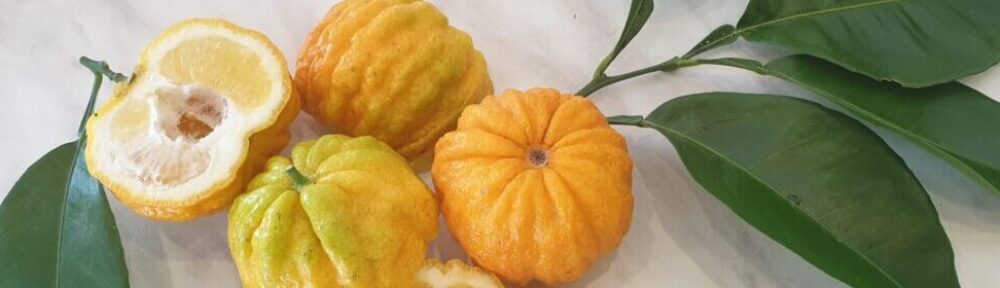
Japanese name: 夏橙 (Natsudaidai); 夏蜜柑 (Natsumikan)
English name: Japanese Summer Orange, Summer Orange
Korean name: 하귤 (Hagyul)
Chinese name: 日本夏橙 (Rìběn xià chéng)
SYNONYMS (selection)
Citrus Natsudaidai Hayata (1919) — valid name under Tanaka’s system; Hayata (1919), Icones Pl. Formos. 9
Citrus × natsudaidai Hayata — nothospecies notation; hybrid origin confirmed by genomic studies
Citrus natsumikan — invalid synonym, still used in part of the specialist literature
TORIGIN AND DISPERSAL
Citrus natsudaidai is a Japanese endemic citrus of natural hybrid origin, whose precise historical circumstances of origin remain a subject of scholarly discussion. All traditional accounts agree on the place of origin — Yamaguchi Prefecture (山口県) in south-western Japan — but dating varies between the late 17th and the late 18th century.
Tanaka (1946) documented the following historical account: the original natsudaidai tree arose during the Tokugawa era on the estate of the Nishimoto family (西本氏) in the locality of Ōhiwa, today part of the Senzaki district of Nagato City, on the peninsula of Aomi-jima island in Yamaguchi Prefecture. Tradition names a woman called Nishimoto Chō (西本チョウ) as founder: during the An’ei era (1772–1780) she reportedly found a seed washed ashore from the south by the Tsushima Current and planted it (Rurubu, 2024; Kandoujumoku, 2024). Tanaka (1946) gives the family name as Nishimoto Sukemitsu (西本助民); this minor discrepancy has not been fully resolved in the available sources. The tree still stands in the Nishimoto family garden and has been protected as a National Natural Monument and Historic Site since 1927 (Tanaka, 1946). The cultivar reached the cultivation centre of Hagi (萩) in Yamaguchi Prefecture during the Bunka period (1804–1818); one version of the tradition states that grower Hagisaki Jūrobyōe (萩崎十郎兵衛) brought a fruit from Ōhiwa and raised a tree from seed, while a second version attributes the introduction to Matahei Kojo (孤城又兵衛), who allegedly brought grafts from a neighbouring domain. In Hagi the tree bore fruit for a long time without the local inhabitants knowing the proper harvest season; overripe fruit was quietly consumed by a servant named Naga-Hyōe Matashō, who was the first to discover the pleasant flavour — an episode that led to the gradual spread of the species in the region. Unripe and overripe fruit created an impression of mystery, earning the species the regional nickname bakemono (literally “monster” or “enigma”).
Genomic studies have substantially refined the position of C. natsudaidai in citrus phylogenetics. Shimizu et al. (2016), using SSR and indel marker analysis of 101 Japanese citrus cultivars, identified the parentage of natsudaidai: allele-sharing points to a cross between pummelo (C. maxima) as maternal taxon and Kishu mandarin (C. kinokuni Tanaka) as paternal taxon. The resulting seed most probably arose as a spontaneous random hybrid from open pollination in a citrus orchard where it was subsequently planted. This interpretation accounts for both the pronounced fruit weight and strong acidity indicating pummelo ancestry and the aromatic profile and more easily peelable rind reflecting the mandarin component. The presence of flavanone neohesperidosides (particularly naringin), typical of pummelo descendants, imparts a characteristic bitter note reminiscent of grapefruit (Omura & Shimada, 2016).
BOTANICAL DESCRIPTION
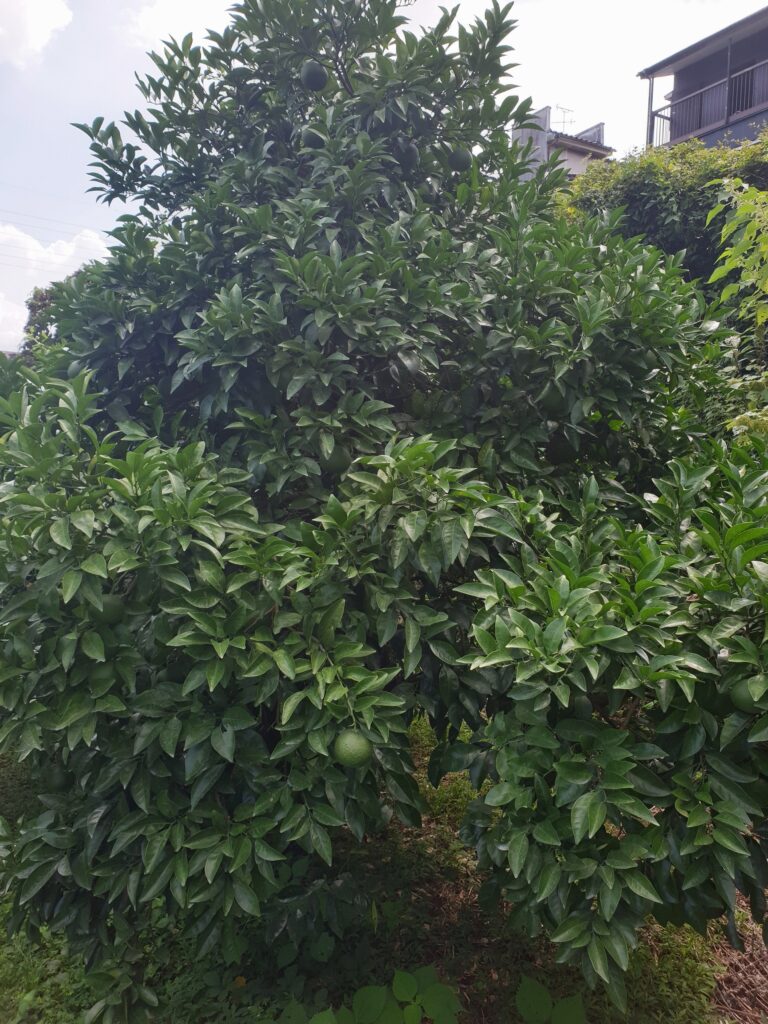
Tree. Citrus natsudaidai is a small to medium-sized tree reaching 4–5 m in height with a tendency to branch from the base. The habit is globose to oblate-globose; branching is dense, with branches spreading obliquely. Frost tolerance is slightly lower than that of Satsuma mandarin (C. unshiu), but heat tolerance is correspondingly higher; in the lowlands of northern Taiwan the tree is grown as a standard cultivated crop. Cropping commences relatively early; productivity is good but with a tendency towards alternate bearing (Tanaka, 1946).
Branches. Branches are rather slender and of medium length. Trees are nearly thornless; new shoots branch into 3–5 secondary shoots per bud. The number of fruit-bearing shoots is 10–20 (Tanaka, 1946).
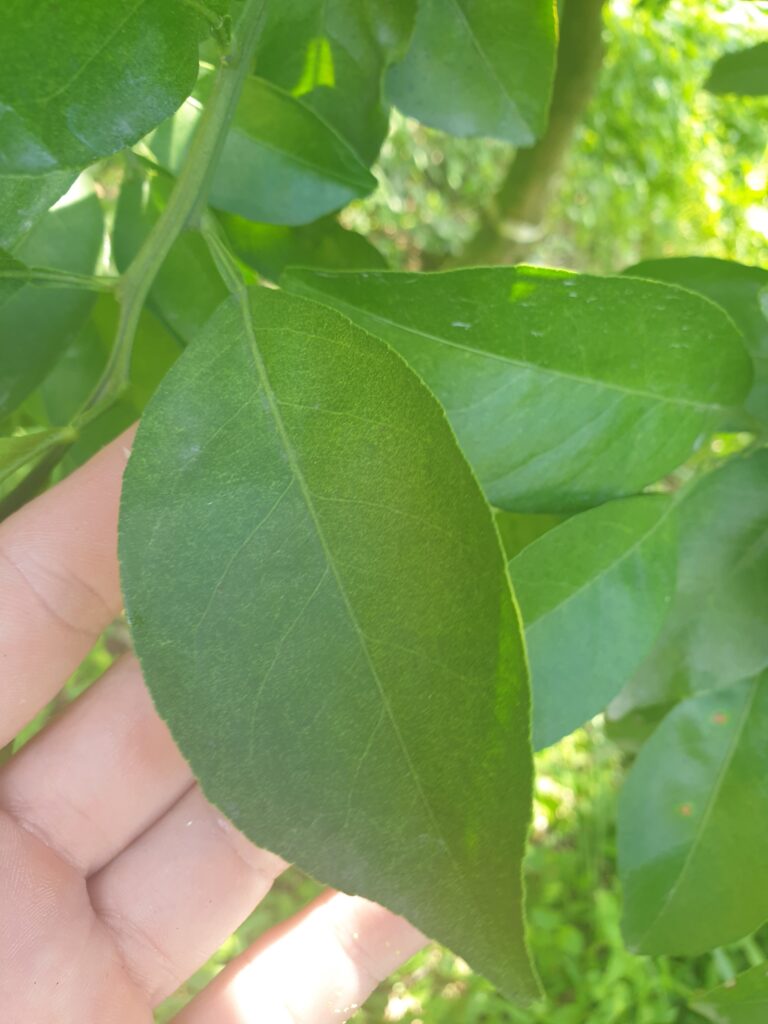
Leaves. The blade is elliptic-lanceolate with a narrowly cuneate base and an obtusely acuminate apex; leaves medium-sized, spreading horizontally or at a slight angle, with pronounced, distinct obtuse serrations and a pale matt lower surface (Tanaka, 1946). Citrus ID notes a narrow to medium-winged petiole; the scent of crushed leaves resembles mandarin (Saville, 2011).
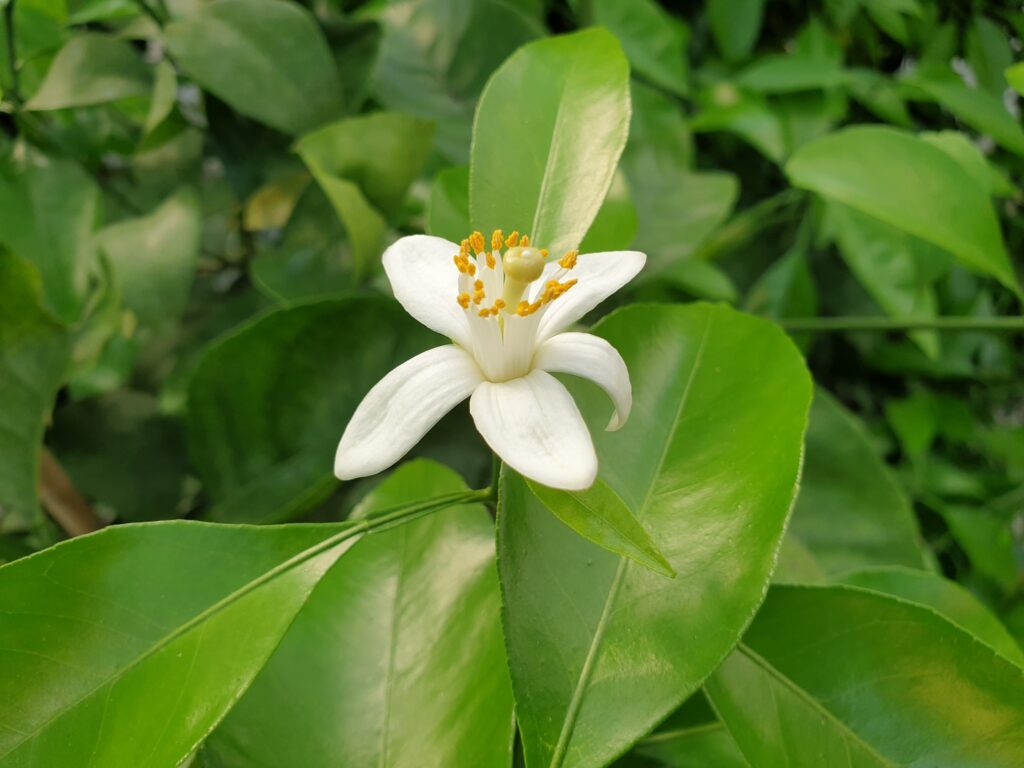
Flowers. Terminal or axillary; occasionally arranged in a raceme of 6–7 white flowers (Tanaka, 1946). The fragrance of natsudaidai flowers is remarkably intense — chemical analysis in 2022 identified 43 aromatic constituents, with linalool (31.14%) dominating. The authors of a study from Yamaguchi University conclude that the absolute from natsudaidai flowers has potential for use in the perfumery industry (Hayasaki et al., 2022).
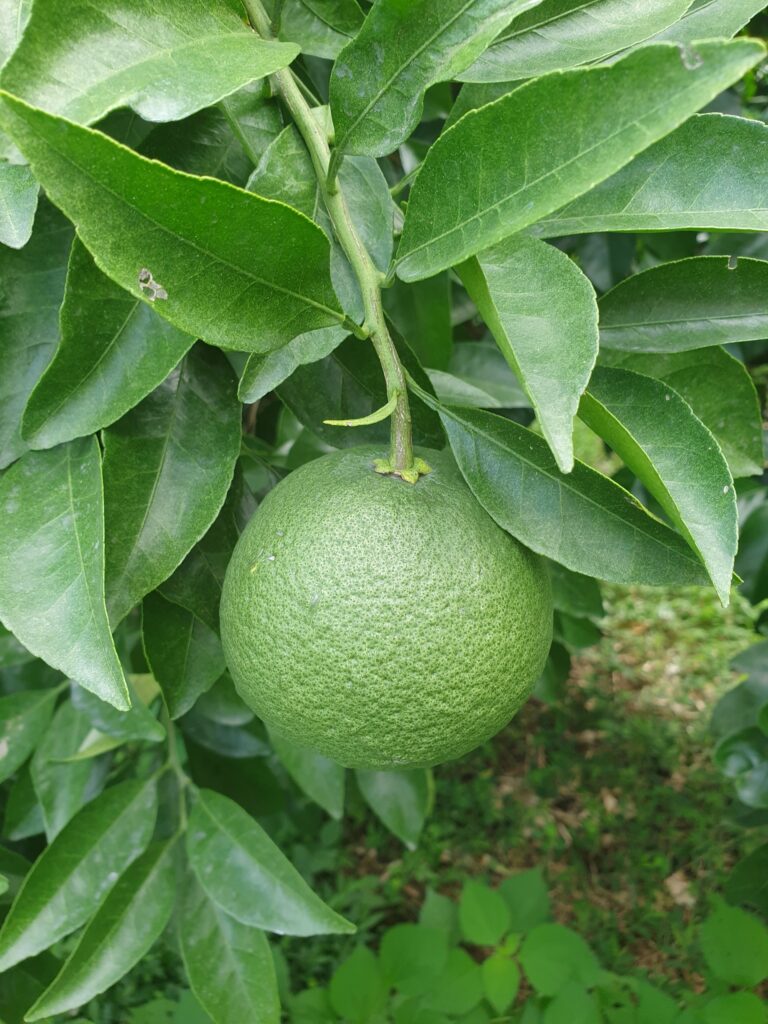
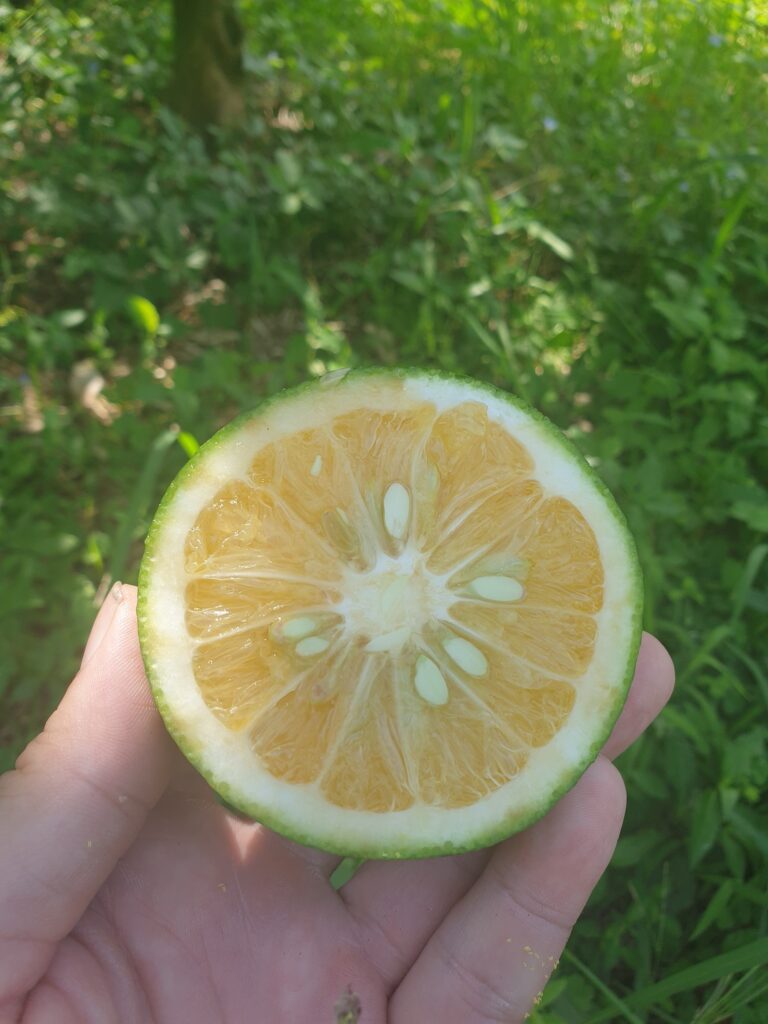
Fruit. Large, oblate-spheroid; longitudinal diameter 7 cm, transverse diameter 11 cm; weight 400–500 g (exceptionally exceeding 600 g). The apex is flattened. Rind surface yellow and rough. Pulp with 10–14 segments, regularly divided; central axis nearly hollow. Juice is abundant, strongly acidic, with low sweetness and a mild bitterness; with the addition of sugar the fruit can be eaten as a dessert even in spring. Seed count 20–30; seeds polyembryonic (Tanaka, 1946).
Harvest and storage. In Japan harvest runs from April to May; fruit keeps in storage throughout the summer. In Taiwan the optimal harvest date was established as February — after this point fruit drops readily (Tanaka, 1946). Tanaka’s phenological records from 1936–1937 show that fruits reach maximum weight (over 480 g) in December; weight then declines slightly while sugar content gradually rises and acidity falls.
Natsudaidai — (basic type)
Japanese name: 夏橙 (Natsudaidai / ナツダイダイ)
Taxonomic position: Citrus natsudaidai Hayata (1919), entry no. 71 in Tanaka (1946)
The original, basic form of natsudaidai. Fruits are strongly acid (acidity 2–3%), weight 400–500 g, rind colour yellow to yellow-orange, ripening late (January–April); fruits are unsuitable for direct consumption without added sugar. Tanaka lists a series of regional synonyms for the basic type: Amashiro (和歌山), Bakemono (山口), Gozen-Kunenbo (山口), Hagi-mikan, Kodama-mikan (山口), Natsu-kunenbo (和歌山・奈良), Natsu-mikan (general), Natsushiro (和歌山・奈良), and Yamaguchi-daidai (静岡) (Tanaka, 1946, entry no. 71).
In Yamaguchi Prefecture the tree has acquired an almost iconic status: the city of Hagi is traditionally renowned for the fragrance of natsudaidai blossoms opening in May. The then Crown Prince Hirohito, who visited Hagi in 1926 during the flowering season, reportedly marvelled at the intensity of the scent, believing it to come from an artificial perfume spray. Hagi was designated a “Fragrant Landscape” (かおり風景100選) by the Japanese Ministry of the Environment (Rurubu, 2024).
Amanatsu / Kawano Natsudaidai
Japanese name: 甘夏 (Amanatsu, read “amanatsu”); 川野夏橙 (Kawano Natsudaidai, read “kawano-natsu-dai-dai”)
Synonyms: Amanatsu-daidai (甘夏橙), Amanatsukan (甘夏柑), Amanatsu-mikan (甘夏蜜柑)
Taxonomic position: Citrus natsudaidai Hayata ‘Kawano Natsudaidai’; somatic mutation of the basic type; accessioned as UCR CRC 3235 in the UCR Givaudan Citrus Variety Collection
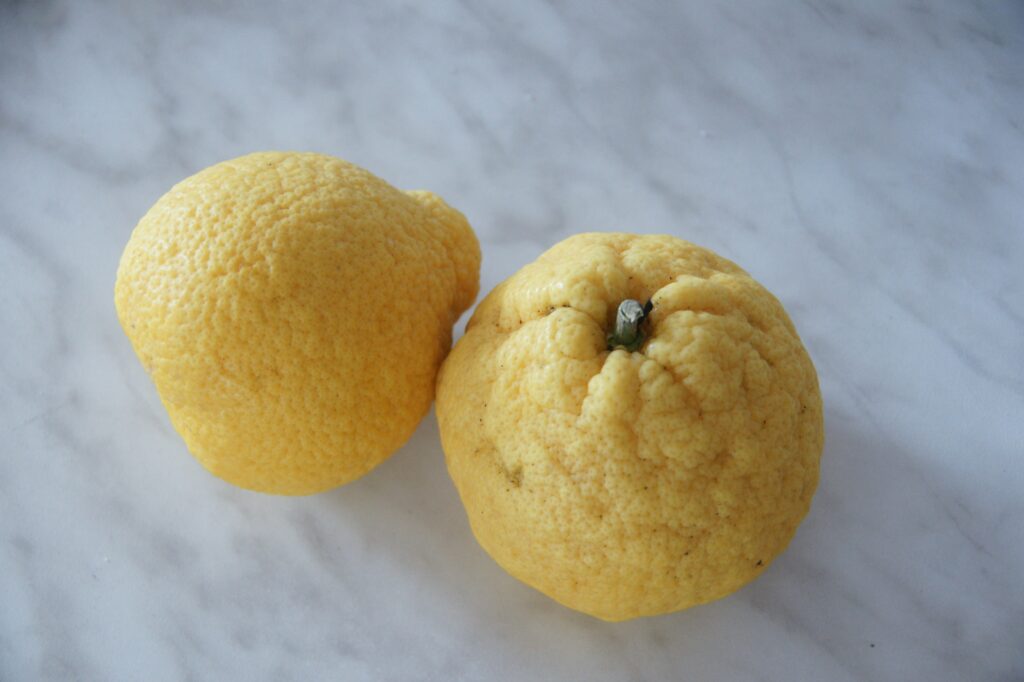
Amanatsu is the most commercially important cultivar of C. natsudaidai and today effectively dominates the market. It arose as a spontaneous bud sport discovered in 1935 on a natsudaidai tree in the orchard of farmer Kawano Yutaka (川野豊) in the town of Tsukumi, Oita Prefecture, on the island of Kyushu. The mutant branch bore fruit with markedly lower acidity; Kawano carried out the first grafting trials. Official registration of the cultivar took place in 1950, when it was confirmed as a commercially viable early-maturing selection. The word ama (甘) means “sweet” in Japanese and natsu (夏) means “summer” — the name thus translates as “sweet summer” (NARO, 2023).
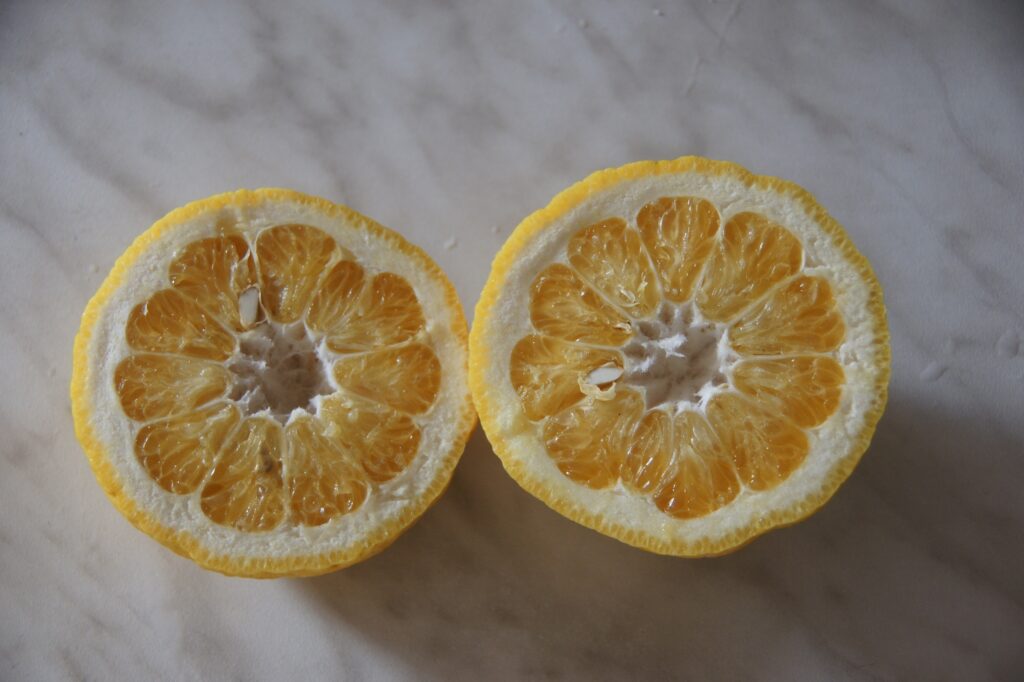
Amanatsu fruits are slightly smaller and smoother than those of the basic natsudaidai (diameter 70–100 mm), weight 400–500 g, rind golden-yellow to orange and smoother with distinct oil glands. Pulp soft, juicy, pale orange, 10–12 segments, 8–10 seeds. Acidity 1–2% (versus 2–3% in the basic type), flavour sweet-acid with a gentle bitterness (NARO, 2023).
Shimizu et al. (2016) confirmed by marker analysis that the tested natsudaidai accessions (A096–A099) are mutually somatic mutants — i.e. different trees of natsudaidai cultivars display identical genotypes, confirming the clonal origin of vegetative propagation.
Beni Amanatsu
Japanese name: 紅甘夏 (Beni Amanatsu, read “beni-amanatsu”)
Taxonomic position: Citrus natsudaidai Hayata; red-coloured bud mutation of Kawano Natsudaidai (Amanatsu)
The genetic resource catalogue of Toso Orchard published by Yamamoto et al. (2005) lists under C. natsudaidai Hayata an accession designated “Beni amanatsu” with the note: “bred at the Prefectural Agricultural Experiment Station of Kumamoto; bud mutation of Kawano Natsudaidai.”
The origin of the mutation is thus institutional: Beni Amanatsu was bred at the Kumamoto Prefectural Agricultural Experiment Station as a bud sport of the Amanatsu cultivar. The nature of the mutation — a deeper orange colouration of both rind and pulp — has been scientifically analysed: Tochida et al. (1985) demonstrated that total carotenoid content in this mutant is approximately twice that of standard natsudaidai and amanatsu, while the carotenoid spectrum (the composition of pigments) is identical — the deeper colour is therefore a quantitative rather than a qualitative change. The same study compared a cultivar in which colouration is caused by the presence of β-citraurin, but this pigment (producing a reddish hue distinct from deep orange) was not detected in Beni Amanatsu.
Kobayashi mikan
Japanese name: 小林蜜柑 (Kobayashi-mikan, read “kobayashi-mikan”)
Synonyms: Williamson Pomelo (Tanaka, 1980, note no. 5 at entry no. 55); Akaniku-amanatsukan (赤肉甘夏柑, read “akaniku-amanatsukan”, Tanaka, 1980, note no. 6)
Taxonomic position: Graft chimera (Citrus Natsudaidai Hayata — L2/L3 — and Citrus unshiu Marcovitch — L1); entry no. 55 in Tanaka (1980), Vol. III; accessioned as UCR CRC 3817
Kobayashi mikan is one of the most remarkable citrus chimeras in Japanese horticulture — a periclinal graft chimera arising spontaneously at the graft union, not through genetic crossing.
History of origin: Around 1908, on the property of Kobayashi Yoshikichi (小林鹿吉方) in the village of Nakazone, Uminomachi district, Fukuoka Prefecture, a natsudaidai scion was grafted onto a Satsuma mandarin rootstock. Early that summer the graft union split; of two adventitious buds that developed, one gave rise to the original tree of this cultivar. In 1922 family members noticed a difference between fruit on two branches: one branch bore normal natsudaidai, the other bore externally similar fruit but with pulp resembling Satsuma mandarin
— both in the reddish colour and in flavour. Prefectural agricultural inspector Samura Ribyōe (佐村利兵衛
) investigated and in 1928 published in the journal Nōgyō oyobi Engei (農業及園芸) the conclusion that this was a graft chimera: the outer cell layer L1 derives from Satsuma mandarin, while the inner layers L2 and L3 are from natsudaidai. This conclusion was confirmed by isoenzyme analysis in later research (Yamashita, 1983, cited in Sugawara et al., 2002) (UCR CRC 3817, 2023).
The botanical description, (according to Tanaka, 1980):
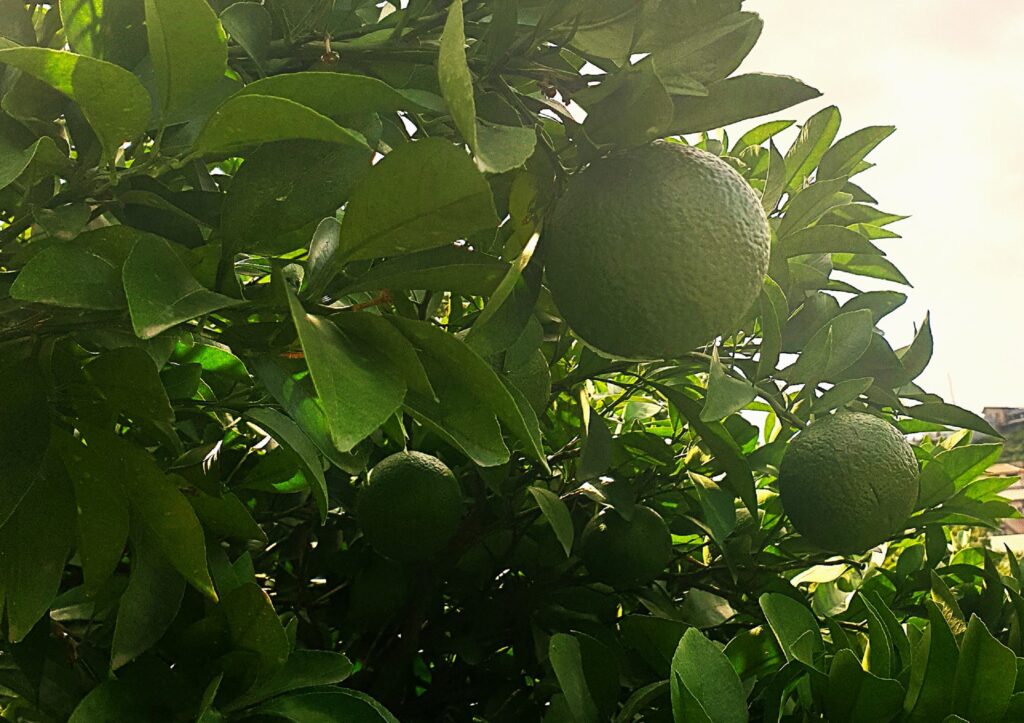
Tree small, branching from the base, globose to oblate crown; slightly shorter than natsudaidai, robust, resistant to pests and diseases. Branches nearly thornless. Leaves: fusiform-lanceolate, 8–10 cm × 4–4.5 cm; gradually acuminate apex, cuneate base; margin with small serrations; petiole ~2 cm, wing 3 mm; blade spreading horizontally, slightly thin, pale green. White flowers borne in clusters on new shoots. Fruit: oblate-spheroid; longitudinal diameter 6.2 cm, transverse diameter 6.4 cm; weight ~200 g — smaller than natsudaidai. Pulp with 13–14 segments and approximately 25 polyembryonic seeds. Sugar content 12.6%, acidity 1.7%, sugar/acidity ratio = 7.4. Fruits ripen by the year’s end. Although the fruit is easily confused with natsudaidai externally, a cross-section provides a reliable distinguishing character. The chimera has maintained stable characteristics after more than 70 years of vegetative propagation in Japan (UCR CRC 3817).
USE AND PRODUCTS
Fresh consumption and gastronomy
Fresh natsumikan and amanatsu fruits are consumed peeled and separated into segments. The Amanatsu cultivar is particularly suited for direct consumption, its sweet-acid flavour with a gentle bitterness being pronounced but pleasant. The more acid basic natsudaidai requires added sugar or post-harvest storage during which acidity declines (UCR CRC 3235). The fruits are processed into juices, jams, marmalades, candied peel, sorbets and ice cream; the city of Hagi is renowned for its natsumikan ice cream and juice. The peel is added to rice oil, used in baking, and employed as an aromatic ingredient in a range of traditional Japanese and international recipes. On the islands of Kyushu and Honshu the fruits are a popular spring citrus — harvested in April and consumed in May, they bridge the off-season gap following the end of the Satsuma mandarin harvest (Hodgson, 1967).
Rind in the bath
Japanese tradition recommends adding whole or dried natsudaidai fruits to a hot bath; the resins and essential oils in the rind are said to improve circulation and relieve fatigue. This practice is documented in Japanese ethnobotanical tradition and forms part of the cultural identity of Hagi and neighbouring areas (Tanaka, 1946).
Perfumery
Cold-pressed rind oil of natsudaidai is aromatic, characterised by β-copaene, cis-sabinene hydrate and 1-octanol; limonene accounts for over 80% of total composition (Lan Phi et al., 2006). The floral absolute contains linalool (31.14%) as the dominant component. Hayasaki et al. (2022) demonstrated that the aromatic composition of the natsudaidai flower absolute is comparable to neroli oil and has potential for use in perfumery and aromatherapy.
Medicinal use
In Japanese traditional medicine (kampō) dried fruit and rind of natsudaidai are used analogously to bitter orange (C. aurantium): as a stomachic and expectorant. Dried unripe rind is known in kampō as 枳實 (kijitsu). Research has demonstrated that the rind of unripe natsumikan fruit has beneficial effects in experimental allergic dermatitis (Deng et al., 2020).
DISTRIBUTION AND CURRENT STATUS
Natsudaidai is a Japanese endemic species, grown commercially exclusively in Japan (and to a limited extent in China, Korea and Europe as a specialist crop). The historical centre of cultivation is Yamaguchi Prefecture (city of Hagi), where the species is a cultural symbol. Current commercial production is concentrated mainly in the prefectures of Kumamoto (熊本), Ehime (愛媛), Kagoshima (鹿児島) and Wakayama (和歌山). Owing to its sensitivity to low temperatures the species is confined to coastal areas with mild winters (Hodgson, 1967; Deng et al., 2020).
Production has undergone a dramatic decline: from a peak of approximately 17,000 ha (1970) and output of around 253,000 tonnes, it fell to approximately 1,600 ha and 40,000 tonnes in 2017 (Kurai, 2021; Shimizu, 2022). The decline is attributed to a shift in consumer preferences towards sweeter and more easily peelable cultivars (dekopon, setoka, kanpei) and competition from imported citrus. The Amanatsu cultivar (Kawano Natsudaidai) maintains a stable market position thanks to its characteristic sweet-acid profile and ease of peeling (Shimizu, 2022).
Introduction to Europe. Natsudaidai reached Europe through a remarkable historical coincidence. In 1933 a Yugoslav merchant vessel brought wheat from the Banat region (a historical territory divided between Romania, Serbia and Hungary) to Japan; from this wheat bread of exceptional taste was baked for the Japanese side. In a gesture of gratitude, the enthusiastic Honorary Consul of the Kingdom of Yugoslavia in Osaka, Eiichirō Ujeyama (上山英次郎), owner of the Kinchō (金鳥) insecticide company, dispatched as a gift on the return vessel 372 citrus saplings — specifically cultivars Satsuma mandarin (C. unshiu), Honikan (probably Hon Mikan, C. kinokuni) and Natsu mikan (C. natsudaidai) (Agroklub, 2009). The shipment arrived at the port of Bar (then Antivari) in Montenegro. The saplings were progressively distributed throughout Dalmatia; material from trees in Blato on the island of Korčula became the basis of the first larger nursery in Opuzen (1951), from which Satsuma mandarin and Natsu mikan spread throughout the entire Neretva Valley, where Satsuma is still grown today (Agroklub, 2009; Japanorama, 2018). The Natsu mikan from this shipment is thus the direct ancestor of specimens of C. natsudaidai cultivated in collection gardens across the territory of the former Yugoslavia and other European countries.
Collection accessions: The basic natsudaidai is accessioned as UCR CRC 3235 (Kawano strain) in the Givaudan Citrus Variety Collection, University of California, Riverside, received in 1957 from Tanaka’s institute, Osaka (UCR CRC 3235). Kobayashi mikan is held as UCR CRC 3817 (UCR CRC 3817). Toso Orchard at Kagoshima University maintains a collection including Kobayashi mikan and Beni Amanatsu (Yamamoto et al., 2005).
TAXONOMIC NOTE
Valid name and author
Citrus natsudaidai Hayata (1919) is recognised as a distinct species within Tanaka’s taxonomic system. The author of the description, Bunzō Hayata (早田文藏, 1874–1934), botanist at Taihoku Imperial University (today National Taiwan University), published the description in Icones Plantarum Formosanarum, Vol. 9.
Genomic position
Shimizu et al. (2016) placed natsudaidai among hybrids with a single identified parental pair on the basis of allele-sharing analysis: C. maxima (pummelo, maternal taxon) × C. kinokuni
Tanaka (Kishu mandarin, paternal taxon). The nothospecies notation Citrus × natsudaidai is used in part of the scientific literature to emphasise the hybrid origin of the species.
Kobayashi mikan as an object of chimaerological research
Kobayashi mikan is a historically documented periclinal graft chimera involving C. natsudaidai as one of its parents, confirmed by isoenzyme analysis (Yamashita, 1983, cited in Sugawara et al., 2002).