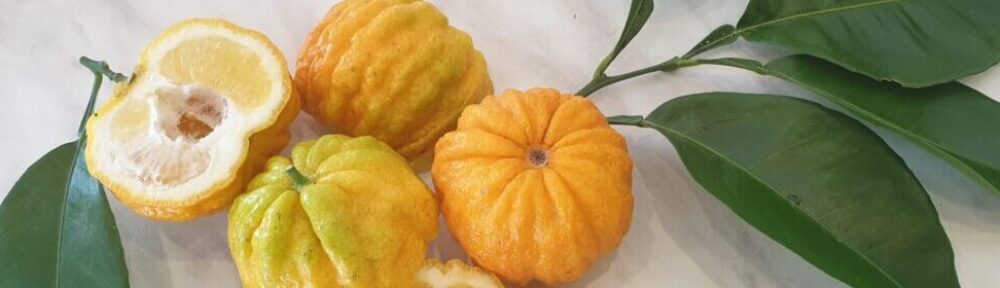
Japanese name: 柑子 (Kōji)
SYNONYMS
– Citrus nobilis Lour. subsp. Suntara Engl. (1931) — botanical synonym
– Kōji-mikan, Usukawa-mikan, Maru-kōji, Komikan (柑子, 薄皮蜜柑, 小蜜柑) — local Japanese names
– Okute-Kōji, Doro-kōji, Noto-mikan — regional names listed in Tanaka
HISTORY AND ORIGIN
Citrus leiocarpa, commonly known by the Japanese name Kōji (柑子), is one of the oldest citrus cultivars grown in Japan. The scientific name Citrus leiocarpa was introduced by Tyōzaburō Tanaka in 1927.The epithet leiocarpa comes from Greek: λεῖος (leîos) = smooth + καρπός (karpós) = fruit, referring to the characteristically smooth, glossy peel of the fruit (Tanaka, 1946).
Origin and genetics: Kōji is considered a Japanese endemic cultivar. Modern molecular analyses (Shimizu et al., 2016) revealed that Citrus leiocarpa is inferred as a hybrid between a genetic ancestor of Kōji (seed parent, hybrid of C. reticulata and C. maxima) and tachibana mandarin (pollen parent, Citrus tachibana).
Historical use: During the Edo period (1603–1868) and probably earlier, Kōji was used for New Year decorations. Leafy branches of Kōji are traditionally used to decorate entrances to homes and shrines during New Year celebrations as part of kadomatsu (門松) — traditional decorations of pine and bamboo intended to attract the deity of the New Year (Toshigami). In this role, Kōji was called komikan (小蜜柑), literally meaning “small mandarin.” The kadomatsu tradition dates back to the Heian period (8th–12th century), with citrus added as a symbol of longevity and prosperity (SANTEN Design, 2025).
After the spread of the commercially successful Satsuma cultivar (Citrus unshiu) during the Meiji period (1868–1912), Kōji’s popularity gradually declined due to its small, very seedy fruits that could not compete with Satsuma (Flower Database. 2025).
BOTANICAL DESCRIPTION
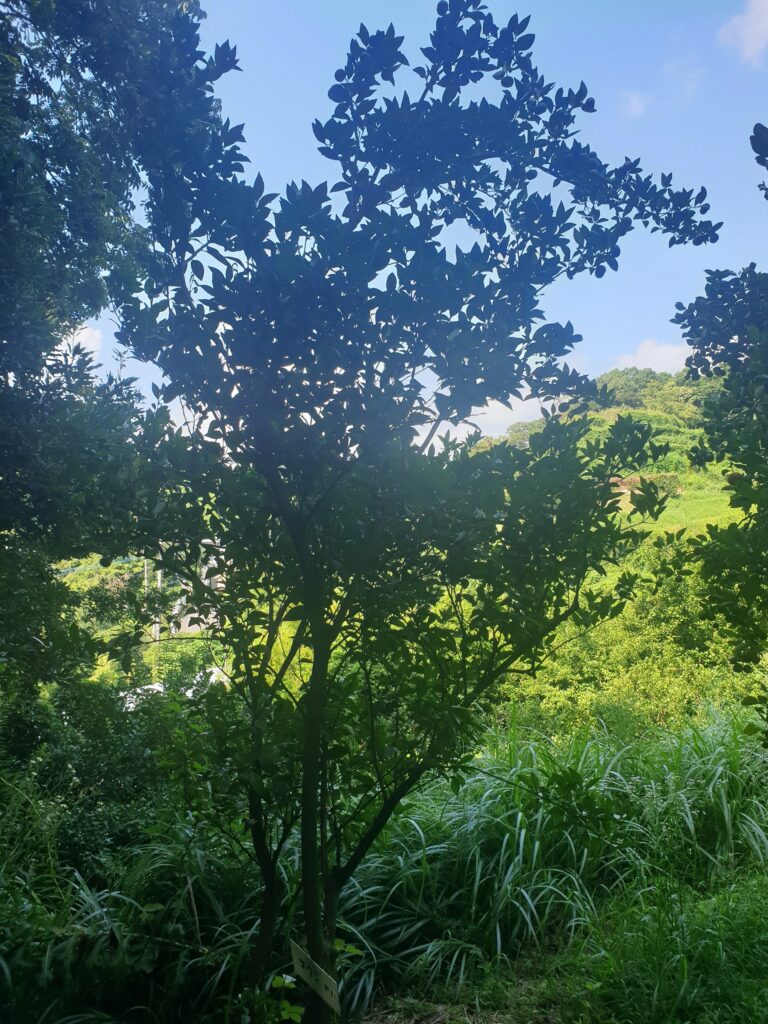
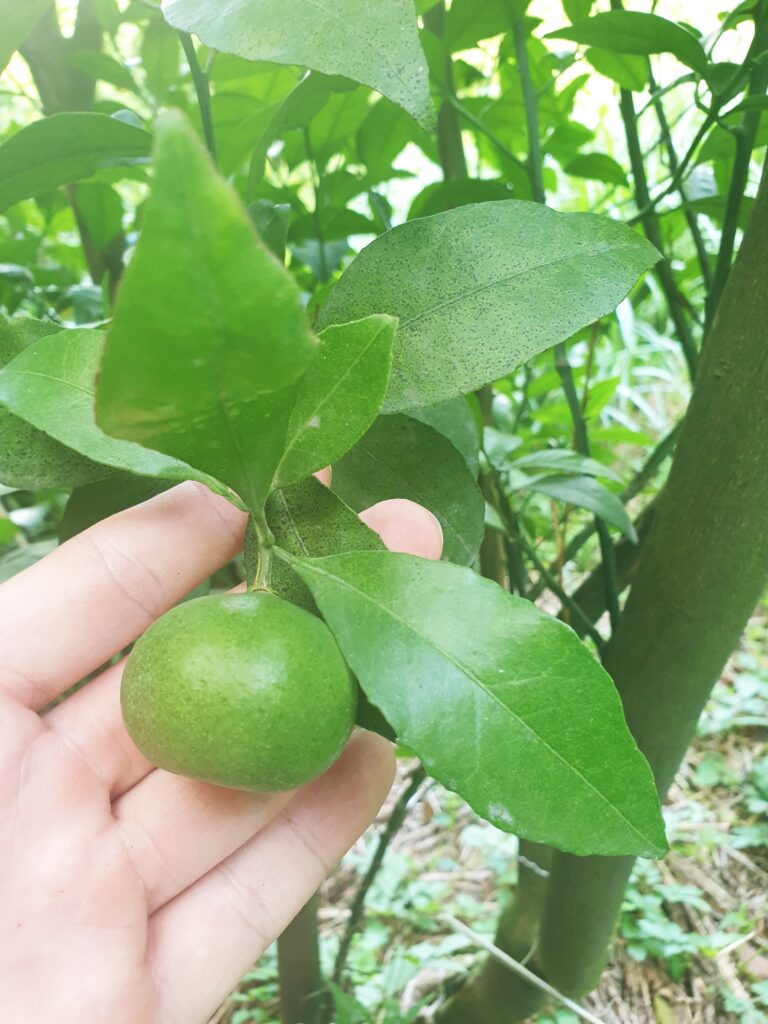
According to Tanaka’s original monograph (1946) the Citrus leiocarpa tree is of medium to tall stature with a densely branched canopy and short, straight trunk. The tree can reach a height of 5–6 meters, with a narrow, upright canopy. Leaves are dark green, elliptic in shape. Flowers appear in May to June, are whitish, with five petals, 1.5–2 cm in diameter, growing singly or in groups of 2–3 (Flower Database, 2025).
Fruits are small, ovate to slightly flattened in shape. According to to Tanaka’s original monograph fruits reach approximately 43 mm in diameter and 46 mm in height. The characteristic diagnostic feature is an extremely smooth, glossy peel — hence the epithet leiocarpa. The peel is thin (approximately 3 mm), practically without visible texture, bright orange. The depression at the apex of the fruit is shallow or almost absent. The flesh is orange. The number of seeds is approximately 15 according to Tanaka (1946), or 15–20 according to observations at UCR Citrus Variety Collection. Seeds are polyembryonic, although UCR notes they may be monoembryonic (UCR. 2025-2).
Monoembryota form: Tanaka (1946) also described the form Citrus leiocarpa f. monoembryota, commonly called Suruga-kōji (駿河柑子). Modern molecular analyses have shown that this is a completely different genetic entity — a hybrid between Kōji and Kishu (Shimizu et al., 2016).
TASTE AND USE
According to Tanaka’s original monograph (1946) the taste of Citrus leiocarpa is distinctly acidic with a bitter aftertaste, explaining why it was not historically consumed as a dessert fruit. Fruits ripen in October to November and during the winter period (November to January) are used for traditional decorations (Tanaka, 1946; Flower Database. 2025).
Traditional use:
New Year decorations (kadomatsu, komikan): Leafy branches of Kōji are traditionally used to decorate entrances during New Year celebrations Medicinal use: The peel and fruits were historically used in traditional medicine (Flower Database, 2025)
Ornamental tree: Small, bright orange fruits are aesthetically attractive
CURRENT STATUS AND DISTRIBUTION
Current distribution in Japan: After the decline of commercial production, Kōji cultivation moved primarily to the San-in and Hokuriku regions (Tottori, Shimane, Fukui, Ishikawa, Toyama) — regions in northern Honshu along the Sea of Japan (Flower Database, 2025).
Conservation: Citrus leiocarpa is preserved in citrus collections in Japan, including the collection at Toso Orchard at the Experimental Farm of Kagoshima University, where it is maintained as a control sample for molecular analyses (Yamamoto et al., 2022).
International distribution: Outside Japan, it is grown in the United States, South Korea, and China, primarily in citrus genebanks. At UCR Citrus Variety Collection in Riverside, California, it is maintained under designation CRC 3147, PI 539276, where it was introduced as seed from H. Yoshimura of Osaka University in 1956. Fruits ripen in Riverside in October to November (UCR, 2025-2).