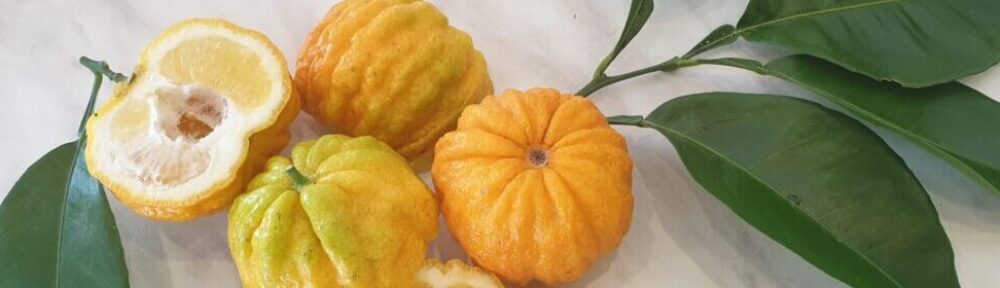
valid name under the Tanaka system; first published in Revisio Aurantiacearum X (Tanaka, 1957)
English name: Deedee (non-standardised)
SYNONYMS
– Dēdē (デーデー) Hort., pronounced „dédé“ — Okinawan dialect name used in the Nakijin-son area; primary vernacular nomenclature of the taxon
– Fūsu (フース) Hort. — Okinawan dialect name in Misato-son; see Taxonomic Note
– Dēdē-kunibu (デーデークニブ) Hort. — name used by older residents of the Tokijin (渡喜仁) district of Nakijin-son; cited in (Ryukyu Shimpo, 2025)
– Nakijin no Dēdē Hort. — name used by Tanaka (1957) for specimens from Nakijin-son
– Shoshi no Dēdē Hort. — name recorded by Inafuku-Teramoto et al. (2010) for the specimen from the Shoshi (
諸志) district of Nakijin-son
TAXONOMIC NOTE
The position of the species in modern and Tanak’s systematics
Classification in Tanaka’s and modern systems
In the Tanaka system, Citrus luteo-turgida is placed in the group ARCHICITRUS–AURANTIUM–OSMOCITRIOIDES–TENUICARPA, the same section as C. tamurana Hort. ex Tanaka (Hyūganatsu), with which it shares a large, globose fruit and a mildly acidic, juicy pulp without pronounced bitterness (Tanaka, 1957). Tanaka nevertheless explicitly noted the morphological differences from C. tamurana: C. luteo-turgida has a distinctly globose (rather than pyriform) fruit shape, a rounded apex without an areola, and differently coloured inner seed coats.
Wu et al. (2021) identify Deedee by genomic analysis as an F1 hybrid of shiikwaasa (C. depressa) and pummelo (C. maxima). This hybrid origin is morphologically consistent with the exceptional fruit size, the relatively thin rind, and the low bitterness; C. depressa contributes the Ryukyuan mandarin lineage, while the pummelo accounts for the generous fruit size and low bitterness.
Under modern taxonomy (POWO), Citrus luteo-turgida is not recognised as a distinct species. For reasons of terminological stability and historical documentary continuity this designation is retained here..
The name Dēdē and the risk of confusion
The name ‘Dēdē’ (デーデー) originally referred in the Nakijin dialect to larger, unusual citrus fruits imported from elsewhere. Inafuku-Teramoto (2011) explains that it functions as a general term for ‘foreign, somewhat larger citrus’ — the same name was applied in this area to sour orange (C. Aurantium, specimen no. 1 of Inafuku-Teramoto et al., 2010) and, in the Shoshi district, also to C. luteo-turgida (specimen no. 28). This synonymy in vernacular nomenclature is characteristic of the southern Japanese islands, where names are established at the level of the village or district rather than the biological species.
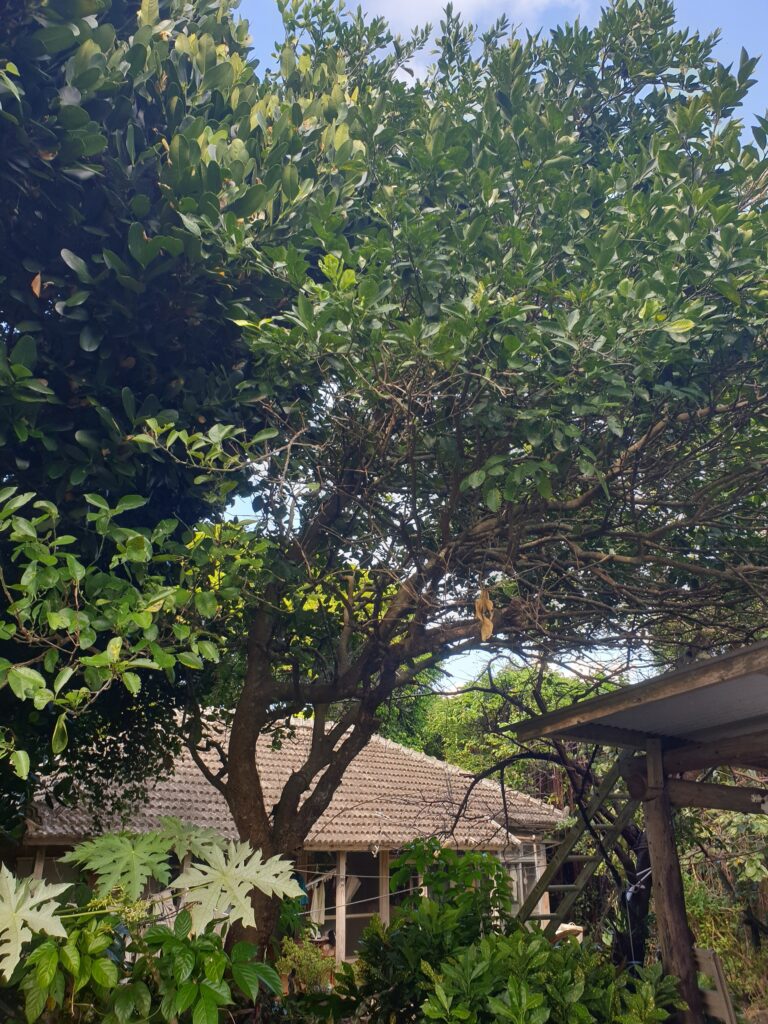
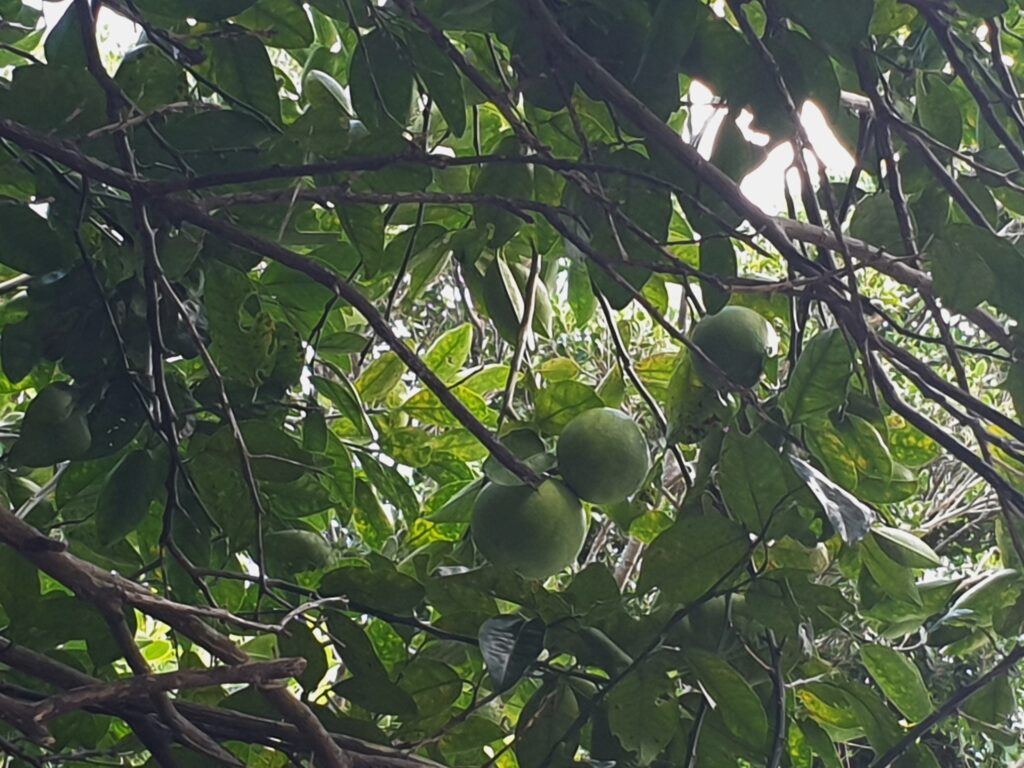
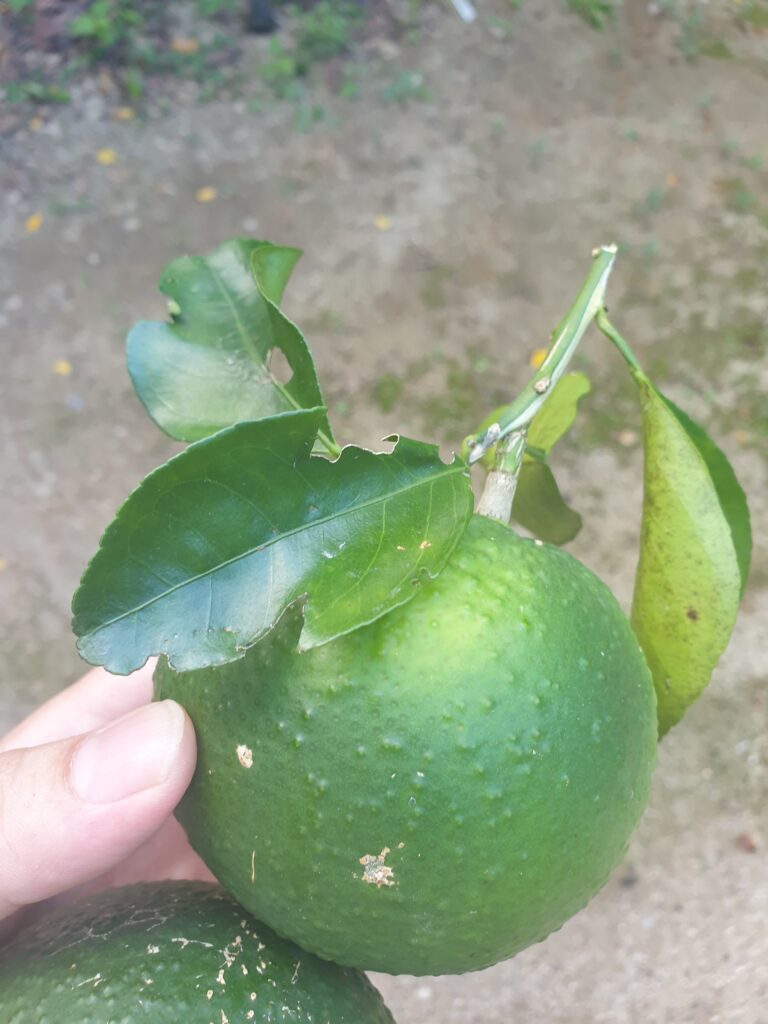
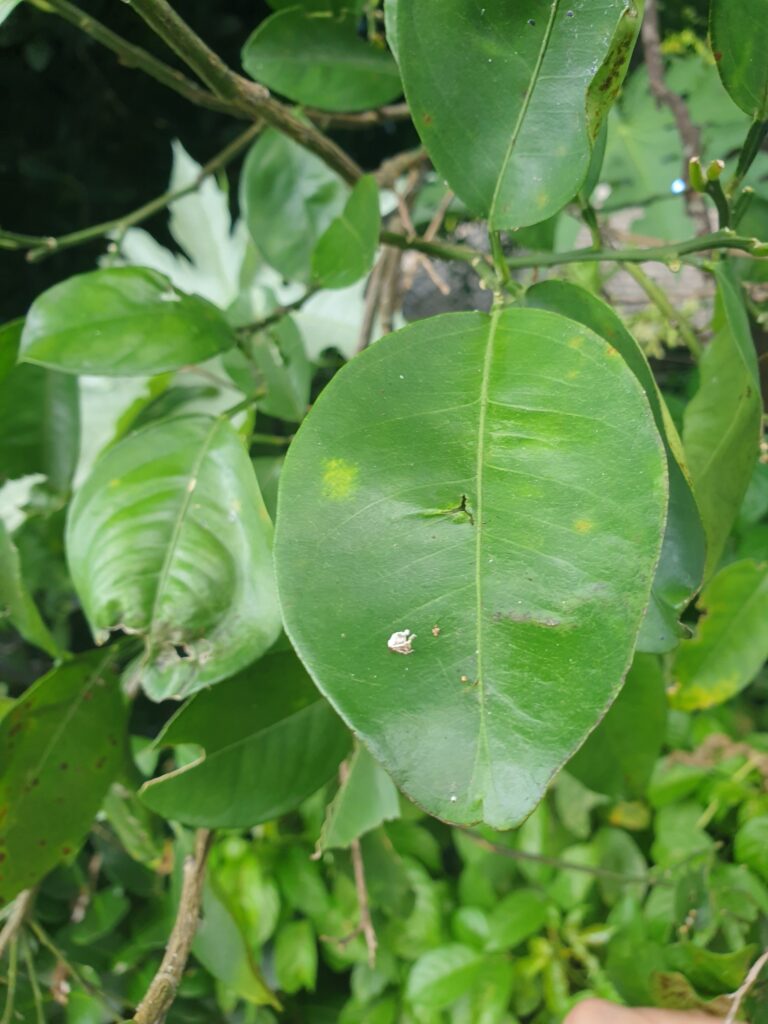
Confusion with sour orange (C. aurantium) is readily excluded on morphological grounds:
C. luteo-turgida differs in its smooth fruit surface, a markedly thinner rind (3.5–5.5 mm versus 8–11 mm in sour orange), and, above all, the low bitterness of the pulp. Sour orange furthermore bears a prominent petiole wing that is absent in C. luteo-turgida (Tanaka, 1957).
Note on the name Fūsu
The local name Fūsu (フース), recorded by Tanaka (1957) for specimens of C. luteo-turgida from Misato-son on Okinawa, is identical to the name Fusu (フス) used for Citrus rokugatsu on Kikaijima Island in the Amami archipelago (Yamamoto et al., 2006). These are homonyms documented on different islands for different taxa; confusion is virtually excluded on morphological grounds.
HISTORY AND ORIGIN
Botanical description and first field collection
Citrus luteo-turgida was formally described by Tyōzaburō Tanaka as a new species (n. sp.) in Revisio Aurantiacearum X (Tanaka, 1957), a systematic account of citrus and related plants of the Ryukyu Archipelago. The author encountered the taxon during a field survey of Okinawa carried out from 17 December 1956 to 19 January 1957. Type specimens were collected on 22 December 1956 from the gardens of three householders in Nakijin-son, northern Okinawa: from the front garden of Sōhachi Matsuda (Nakasone district), from the garden of Nabe Uchima (Shoshi district, 諸志), and from the front garden of Hakuan Uema (Sakiyama district; several trees). Leaf samples were additionally collected on 10 January 1957 in Misato-son, Ikebaru area, from Seian Yonamine.
Tanaka explicitly noted that all specimens examined were cultivated material and that it was difficult to determine whether the taxon represents a native (endemic) element or a cultigen arising from a chance seedling. He proposed the most probable scenario to be the origin from a chance seedling in central Okinawa, from where the taxon subsequently spread to northern districts.
Trade-route origin and the pummelo import hypothesis
Inafuku-Teramoto et al. (2010) subsequently examined the specimen from the Shoshi district of Nakijin-son as part of an extensive survey of the northern portion of Okinawa Island. The authors note that the occurrence of ‘Shoshi no Dēdē’ is confined to a single settlement in Nakijin that lies immediately adjacent to a historic trading harbour which served as a shelter from storms (Inafuku-Teramato, 2011). On the basis of this geographical situation and the fact that the taxon possesses ‘entirely different characteristics from other local citrus’, the authors hypothesised that it reached this locality during the Ryukyu Kingdom period (approximately 1200–1800) through the introduction of propagule material brought from China or South-East Asia by vessels using this harbour.
The hybrid origin — C. depressa × C. maxima as confirmed by Wu et al. (2021) — suggests that one of the two parent taxa, pummelo (C. maxima), was most probably introduced, since pummelo does not occur spontaneously in its original form on Okinawa. This scenario is consistent with the historical record of trade relations between the Ryukyu Kingdom and China (where pummelo is widely cultivated) and with the exceptionally localised present-day distribution of the taxon.
GENETIC CHARACTERISTICS
Wu et al. (2021) compared 69 new East Asian genomes and identified Deedee (C. luteo-turgida) as a hybrid of Shiikwaasa × pummelo — that is, a cross between C. depressa and C. maxima. The accession included in the analysis is designated R00 and originates from the Tokijin (渡喜仁) district of Nakijin on Okinawa. It is the tree belonging to Mr. Noboru Teruya (Ryukyu Shimpo, 2025). also contextualises Tanaka’s comparison with C. tamurana: both cultivars share the influence of pummelo, but C. tamurana has a different origin (C. aurantium × C. maxima), whereas C. luteo-turgida arose through hybridisation within the Ryukyuan lineage.
In the analysis of polymethoxyflavones (PMFs) in unripe rind, Shoshi no Dēdē was assigned to the ‘other/unclassified’ group with a total PMF content of 1.63 mg·g⁻¹ DW — the lowest value among all 30 specimens examined. This result is consistent with the influence of pummelo, which has a generally low PMF content (Inafuku-Teramato et al., 2010).
BOTANICAL DESCRIPTION
According to Tanaka’s monograph (1957) the tree of C. luteo-turgida is fairly tall and vigorous. Tanaka notes that its growth habit makes it a promising candidate for use as a rootstock.
Leaves comparatively large, exceeding 10 cm in length; lamina oval to ovate-elliptic (10 × 5.5 cm), apex obtuse or slightly acuminate or slightly emarginate, base obtuse or locally slightly narrowed; petiole comparatively long (often reaching 2 cm), wing narrow, sometimes reaching 5 mm in width, but generally narrower or merely fringed.
Fruits nearly globose, comparatively large; diameter frequently exceeding 9 cm, height approximately 8 cm; weight 230–270 g according to Tanaka (1957), mean 200–368 g according to Inafuku-Teramoto et al. (2010). Apex completely rounded, almost smooth at the stylar point, areola absent. Base shallowly concave, without radial grooves. Surface turgid, greenish to light yellow (Inafuku-Teramoto et al, 2010), smooth. Rind thin, uniformly 3.5–5.5 mm thick according to Tanaka (1957), mean 3.1–4.3 mm according to Inafuku-Teramoto et al. (2010); albedo white. Segments 8–10; segment wall comparatively firm, segments tightly adherent. Central column small to very small.
Pulp very juicy, light yellow to pale orange-yellow; initially strongly acid; acidity decreasing and sugar content rising with maturity; free of bitterness. Soluble solids approximately 11.2 ± 0.6 °Brix, acidity 2.68 % (Inafuku-Teramato et al., 2010); values at full maturity). Seeds large, ovoid-oblong; containing pale green polyembryonic embryos.
FLAVOUR AND USE
Tanaka (1957) describes the pulp as very juicy and strongly acid but progressively gaining sweetness and entirely free of bitterness. Inafuku-Teramoto (2011) notes in her doctoral thesis that the fruit tastes entirely different from sour orange, with a refreshing, grapefruit-like flavour — and that it is precisely this agreeable taste that has led the community of Shoshi to preserve and maintain the taxon through local tradition. The measured values of acidity and sugar content are consistent with an aromatic acid citrus suitable for processing (juices, sauces) or for use in fragrant baths.
Mr. Noboru Teruya, the owner of the tree in Tokijin (Nakijin-son), uses the fruits as gifts for friends and appreciates the fragrant bath with the fruit, a practice known locally as ‘dēdē-burō’’ (Ryukyu Shimpo, 2025). This use is consistent with the traditional employment of aromatic hybrids of the sour-orange lineage.
CONSERVATION AND CURRENT STATUS
In Japan
Citrus luteo-turgida is among the most critically threatened taxa of the Japanese citrus flora. Based on available sources, only the following specimens are documented on Okinawa Island:
The specimen belonging to Mr. Noboru Teruya (照屋昇), aged 85, in the Tokijin (渡喜仁) district of Nakijin-son was genomically identified by Wu et al. as accession R00 (Wu et al., 2021). The tree grows spontaneously, reaches a height of approximately 5 m and an estimated age of over 30 years; it bears fruit every other year. The tree was visited by the author of this article together with Dr. Kinjō in September 2025. Older residents of the Tokijin district refer to the tree as ‘dēdē-kunibu’ (Ryukyu Shimpo, 2025).
Inafuku-Teramoto et al. (2010) document a further specimen from the Shoshi (諸志) district of Nakijin-son (their specimen no. 28, ‘Shoshi no Dēdē’). At the time of the survey (2008) this specimen was a sucker from an original tree that had already died; the sucker was estimated at 60 years of age, while the original tree was reported by local informants to have been over 100 years old.
At the time of author’s visit, the taxon was not held in the citrus collection of the Okinawa Prefectural Agricultural Research Center, Nago Branch (Ogimi).
The NARO genebank (NARO Institute of Fruit Tree and Tea Science, Ano, Japan) holds this cultivar in its citrus collection under accession JP 117375 (Naro Genebank, 2026).
In Europe
The taxon is not documented in any European collection, and its presence there cannot be expected given its extreme rarity even in Japanese holdings. It has not been assigned an accession number in the UCR Citrus Variety Collection at Riverside, California.